
 Sign In


Every statistic in this article was checked against its original source on October 21, 2026.
Italian for beginners starts with five things: pronunciation rules, the verbs essere and avere, articles with every noun, the present tense, and a set of survival phrases. Those five give you enough to introduce yourself, ask questions and follow slow conversation within about three months.
Italian rewards English speakers quickly, because its spelling is regular and thousands of words look familiar. The challenge is order. Students who start with long word lists stall, while students who start with sounds and core verbs move fast. This guide lays out what to learn and when, and the LanguageBird Italian program page shows how live one to one classes follow the same path.
Quick Answer
The first five things to learn in Italian are its pronunciation rules, the two core verbs essere (to be) and avere (to have), the articles that go with every noun, regular present tense endings, and survival phrases such as buongiorno, per favore and non capisco. With daily practice, most beginners can hold a simple conversation within 90 days.
Key Takeaways
- The US Foreign Service Institute lists Italian at 24 weeks, or about 600 class hours, for English speakers to reach professional proficiency.
- Italian spelling is regular, so once you know a dozen letter combinations you can read almost any word aloud.
- Every Italian noun is masculine or feminine, and Italian has seven forms of “the”: il, lo, l’, la, i, gli and le.
- Regular verbs fall into three groups by their endings: are, ere and ire.
- Double consonants change meaning, so pena means pity and penna means pen.
What should you learn first in Italian?
Learn the sounds first, then the two core verbs, then articles with nouns. This order lets you read aloud correctly from the start and build real sentences within the first week.
| Order | What to learn | Why it comes here |
|---|---|---|
| 1 | Pronunciation rules | Every word after this is read correctly the first time |
| 2 | Essere and avere | They form basic sentences and later the past tense |
| 3 | Articles and noun gender | Every noun needs one, so learn them together |
| 4 | Present tense of regular verbs | Covers most everyday statements |
| 5 | Survival phrases | Lets you use Italian with real people right away |
Italian is a Romance language with a lot in common with Spanish and French. Our article on whether Italian is hard to learn covers which parts take English speakers longest.
As a native English speaker and a student of Italian myself, I bring a helpful perspective to the challenges of learning the language, along with a deep passion for all things Italian.
Alex B, Italian Instructor at LanguageBird
How do you pronounce Italian?
Italian pronunciation follows a short list of regular rules, which makes it one of the fastest parts for beginners. Once you know about a dozen letter combinations, you can read nearly any Italian word aloud.
| Letters | Sound | Example | Meaning |
|---|---|---|---|
| c before e or i | ch as in church | cena | dinner |
| ch | k as in kite | chiesa | church |
| g before e or i | j as in jam | gelato | ice cream |
| gh | g as in go | spaghetti | spaghetti |
| gli | close to lli in million | famiglia | family |
| gn | ny as in canyon | gnocchi | gnocchi |
| sc before e or i | sh as in shoe | scienza | science |
| z | ts or dz | pizza, zero | pizza, zero |
| h | always silent | ho | I have |
| double consonants | held longer | penna vs pena | pen vs pity |
Italian vowels are pure and clear. Each one keeps the same quality, without the glide English adds to words like “go”. Stress usually falls on the second to last syllable, and a written accent appears only when the final syllable is stressed, as in città and caffè.
Which Italian verbs should beginners learn first?
Start with essere (to be) and avere (to have). They are irregular, they appear in almost every conversation, and they are the helper verbs for the most common past tense.
| Subject | essere (to be) | avere (to have) |
|---|---|---|
| io (I) | sono | ho |
| tu (you, informal) | sei | hai |
| lui, lei, Lei (he, she, you formal) | è | ha |
| noi (we) | siamo | abbiamo |
| voi (you all) | siete | avete |
| loro (they) | sono | hanno |
Italian drops the subject pronoun most of the time, because the verb ending shows who is speaking. Sono stanco means “I am tired”, with no io needed. Use io only for emphasis.
Next, learn the regular present tense. Italian verbs fall into three groups by their infinitive endings: are, ere and ire.
| Subject | parlare (to speak) | credere (to believe) | dormire (to sleep) |
|---|---|---|---|
| io | parlo | credo | dormo |
| tu | parli | credi | dormi |
| lui, lei | parla | crede | dorme |
| noi | parliamo | crediamo | dormiamo |
| voi | parlate | credete | dormite |
| loro | parlano | credono | dormono |
Some ire verbs add isc in most forms, such as finire, which gives finisco and finisci. Learn those as a small group once the main pattern feels natural.
How do Italian articles and nouns work?
Every Italian noun is masculine or feminine, and the word for “the” changes with the noun’s gender, number and first letter. Learning each noun with its article is the habit that saves the most time later.
| Masculine | Feminine | |
|---|---|---|
| Singular, most nouns | il libro (the book) | la casa (the house) |
| Singular, before a vowel | l’amico (the friend) | l’amica (the friend) |
| Singular, before s plus consonant or z | lo studente (the student) | |
| Plural, most nouns | i libri (the books) | le case (the houses) |
| Plural, before a vowel, s plus consonant or z | gli amici, gli studenti |
Italian plurals change the final vowel instead of adding s. Nouns ending in o become i, and nouns ending in a become e. Words borrowed from English, such as il computer, usually stay the same in the plural.
What are the most useful Italian phrases for beginners?
These phrases cover greetings, politeness and the moments when you do not understand, which is most of a beginner’s first conversations.
| Italian | English | When to use it |
|---|---|---|
| Buongiorno | Good morning, hello | Formal greeting until mid afternoon |
| Buonasera | Good evening | Formal greeting later in the day |
| Ciao | Hi, bye | Friends and family only |
| Per favore | Please | Everywhere |
| Grazie | Thank you | Everywhere |
| Prego | You are welcome | Reply to grazie |
| Mi chiamo… | My name is… | Introductions |
| Non capisco | I do not understand | When you are lost |
| Può ripetere, per favore? | Could you repeat, please? | Formal request |
| Quanto costa? | How much does it cost? | Shopping |
Italian has a formal “you”, Lei, used with strangers, teachers and older people. It takes the same verb form as lei (she), so Lei è italiano? means “Are you Italian?” in a formal register. Beginners should use Lei with adults they do not know.
How can English speakers use cognates in Italian?
English shares thousands of Latin based words with Italian, and many follow predictable patterns. Recognizing them speeds up reading in the first month.
| English ending | Italian ending | Examples |
|---|---|---|
| tion | zione | nation, nazione; information, informazione |
| ty | tà | city, città; university, università |
| ous | oso | famous, famoso; curious, curioso |
| ent | ente | student, studente; different, differente |
Watch for false friends. Camera means room, and a camera is a macchina fotografica. Fattoria means farm, while a factory is a fabbrica. Libreria means bookstore, and the word for library is biblioteca.
What does a 90 day Italian plan look like?
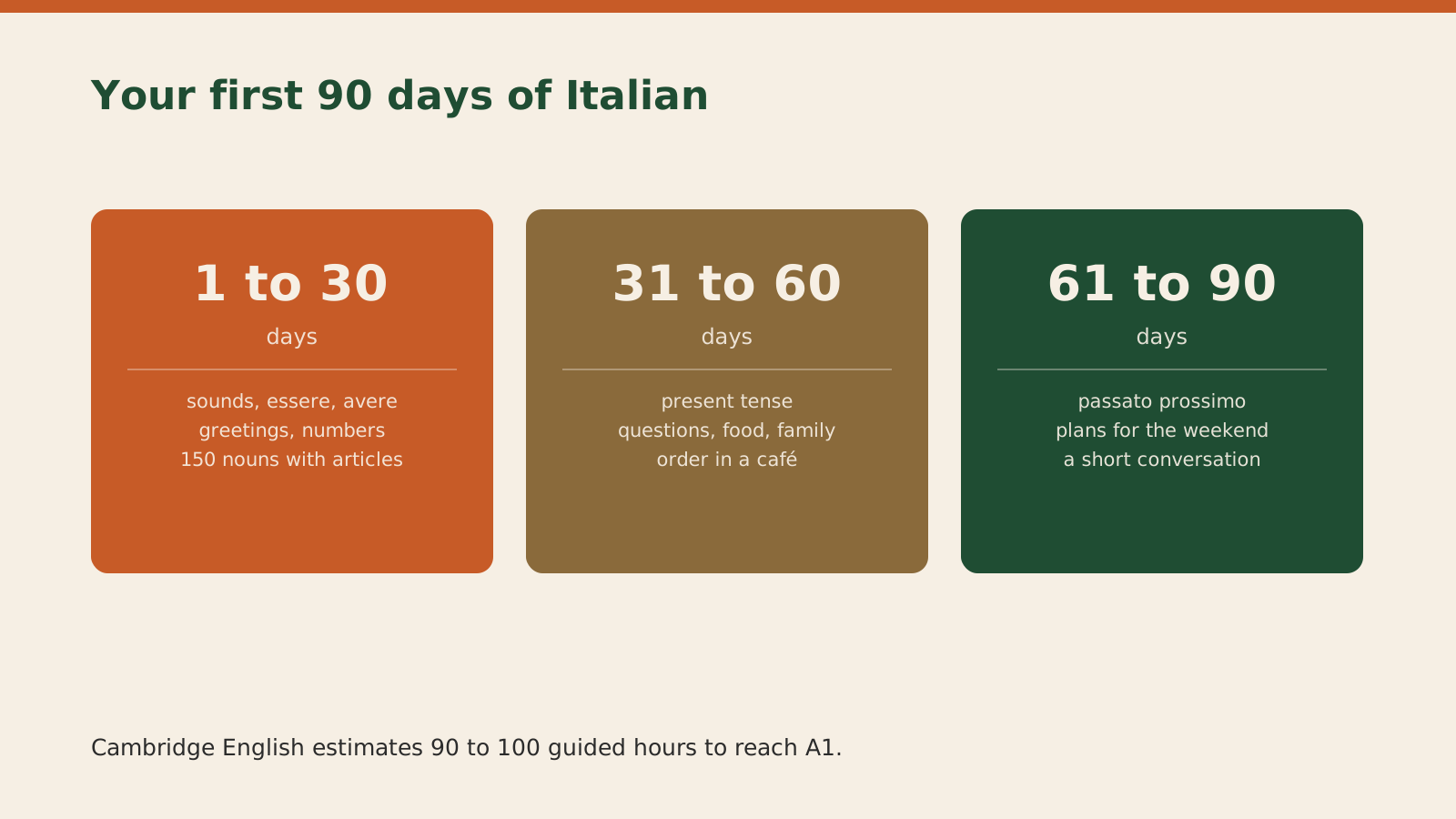
A 90 day plan works best in three stages of about 30 days each, with short daily study and regular speaking practice. The goal for day 90 is a simple, real conversation.
| Stage | Focus | By the end you can |
|---|---|---|
| Days 1 to 30 | Pronunciation, essere and avere, greetings, numbers, 150 common nouns with articles | Read aloud, introduce yourself, say where you are from and how old you are |
| Days 31 to 60 | Regular present tense, questions, adjectives, food, family and daily routine | Describe your day, ask simple questions, order in a café |
| Days 61 to 90 | Passato prossimo with avere and essere, near future plans, 500 words total | Talk about last weekend, make plans, hold a short conversation |
Cambridge English, in its 2013 guide to the CEFR, estimates about 90 to 100 guided learning hours to reach A1, the first level. At about an hour a day, that fits inside the first 90 days, which matches what most motivated beginners experience.

How long does it take to learn Italian?
The US Foreign Service Institute lists Italian at 24 weeks, or about 600 class hours, of full time study for professional proficiency. Most learners with regular lessons reach comfortable conversation in one to two years, as our guide on how long it takes to learn Italian explains in detail. Regular speaking practice moves that timeline more than anything else, and our Italian program builds it in through live one to one classes with native level instructors.
What do beginners get wrong about Italian?
A few assumptions slow beginners down or send them in the wrong direction.
| Common belief | What is actually true |
|---|---|
| You should start with a long vocabulary list | Sounds, essere, avere and articles come first and make every later word usable right away |
| Italian pronunciation is hard | The rules are regular. Double consonants and rolled r take practice, but the system is consistent |
| You need to learn a dialect to understand Italians | Standard Italian is understood everywhere in Italy |
| Ciao works with everyone | Ciao is informal. Use buongiorno or buonasera with adults you do not know |
| Knowing Spanish means you know Italian | You will recognize a lot, but false friends and pronunciation still need work |
Italy does have many regional dialects, and some are very different from standard Italian. Our guide to Italian dialects explains them, but beginners can safely focus on standard Italian.
Should you learn Italian or Spanish first?
If you are deciding between the two, both are in the FSI’s fastest category for English speakers, at 24 weeks for Italian and 30 for Spanish, and Ethnologue has estimated 82 percent lexical similarity between them. Our comparison of Italian vs Spanish covers the differences and helps you choose. LanguageBird teaches both languages in live one to one classes with native level instructors.
Frequently Asked Questions About Italian for Beginners
What is the best way to start learning Italian?
Start with pronunciation, because Italian spelling is regular and you can read any word correctly once you know the rules. Then learn essere and avere, articles with every noun, and regular present tense verbs. Add survival phrases from the first week and practice them aloud with a teacher or a native speaker as early as possible.
Is Italian easy for beginners?
Italian is one of the faster languages for English speakers. The US Foreign Service Institute lists it at about 600 class hours, the shortest category. Regular spelling and many familiar words help a lot. Beginners still need time for gender agreement, verb endings, double consonants and the avere or essere choice in the past tense.
How many words do you need to speak basic Italian?
About 500 words cover simple everyday conversation, and 1,000 to 2,000 words let you handle most daily situations. Focus on high frequency words, such as verbs like essere, avere, fare and andare, along with question words, numbers and common nouns. Learning each noun with its article saves time later.
What are the most important Italian verbs for beginners?
Essere (to be) and avere (to have) come first, because they appear constantly and form the passato prossimo. After them, learn fare (to do or make), andare (to go), volere (to want), potere (can) and dovere (must). Together these verbs let beginners describe themselves, make plans and ask for what they need.
Can I learn Italian in 3 months?
You can reach a solid beginner level in three months with daily study and regular speaking practice. That usually means introducing yourself, ordering food, asking questions and talking about your day in simple sentences. Comfortable conversation takes longer, usually one to two years with regular lessons, depending on weekly practice time.
Should beginners learn Italian dialects?
No. Beginners should learn standard Italian, which is used in schools, news, government and media and is understood everywhere in Italy. Regional dialects can be very different, but most Italians switch to standard Italian when speaking with learners. Dialects make a good later interest, especially for students with family ties to a region.
Can you earn high school credit for Italian online?
Yes. If a high school does not offer Italian, students can take it through an accredited online school and add the credit to their transcript once a counselor approves the transfer. LanguageBird offers accredited middle and high school credit in Italian through live one to one classes with native level instructors, and the high school course catalog lists the Italian courses.
Start Italian With a Live Instructor
The first 90 days decide whether Italian becomes a habit. Pronunciation, articles and the first verbs settle fastest when someone hears you, corrects you and keeps you speaking from the very first lesson.
LanguageBird offers live one to one classes with native level instructors in more than a dozen languages. Students can earn accredited middle and high school credit, and our A to G approved courses count toward University of California admission requirements. Explore the Italian program or browse the high school course catalog.
Sources
- US Department of State, Foreign Service Institute: Foreign Language Training (opens in a new tab)
- Cambridge English, Guided learning hours (opens in a new tab)
- Ethnologue, lexical similarity estimates