
 Sign In


Every statistic in this article was checked against its original source on October 21, 2026.
Mandarin Chinese and Japanese are unrelated languages that share one thing: Chinese characters. Mandarin is written only in characters and uses four tones, while Japanese mixes those characters, called kanji, with two phonetic scripts and has no tones in the Mandarin sense.
That shared writing history is why so many people search Chinese vs Japanese and expect two versions of one language. Grammar, sound and vocabulary tell a different story. This guide compares them point by point, with a three way table that adds Korean. For live one to one classes in either language, see the LanguageBird Mandarin program and the Japanese program.
Quick Answer
Mandarin uses four tones and writes only in Chinese characters. Japanese mixes kanji with two phonetic scripts, hiragana and katakana, and has no tones in the Mandarin sense. Mandarin grammar has almost no verb endings, while Japanese verbs change for tense and politeness. Both take about 2,200 class hours, according to the US Foreign Service Institute.
Key Takeaways
- Mandarin and Japanese belong to different language families, Sino Tibetan and Japonic, so their grammar and core vocabulary are unrelated.
- Japanese borrowed Chinese characters, and the official Jōyō list of everyday kanji contains 2,136 characters.
- Mandarin has four tones, and changing the tone changes the meaning of a syllable.
- Mandarin verbs do not change form, while Japanese verbs change for tense, negation and politeness.
- The US Foreign Service Institute rates both languages at 88 weeks, or about 2,200 class hours, for English speakers.
What is the main difference between Chinese and Japanese?
The main difference is that Mandarin is a tonal language written only in characters, while Japanese is a non tonal language written in a mix of characters and phonetic scripts. Beyond the characters, the two languages share very little.
| Feature | Mandarin Chinese | Japanese |
|---|---|---|
| Language family | Sino Tibetan | Japonic |
| Writing | Chinese characters only | Kanji plus hiragana and katakana |
| Tones | Four tones plus a neutral tone | No tones, a lexical pitch accent |
| Word order | Subject, verb, object | Subject, object, verb |
| Verb endings | None for tense or person | Change for tense, negation and politeness |
| Grammar markers | Word order and small particles | Particles after nouns: wa, ga, o, ni |
| Politeness | Mostly through word choice | Built into verb forms |
| FSI estimate | 88 weeks, about 2,200 hours | 88 weeks, about 2,200 hours |
The two languages are unrelated by family the way English and Hungarian are unrelated. Japanese borrowed thousands of words and characters from Chinese over many centuries, which explains the overlap in writing and in some formal vocabulary.
How are Chinese and Japanese characters different?
Chinese and Japanese characters share the same origin, and many still look alike and carry similar meanings. They differ in how many are used, how they are simplified, and especially in how they are read aloud.
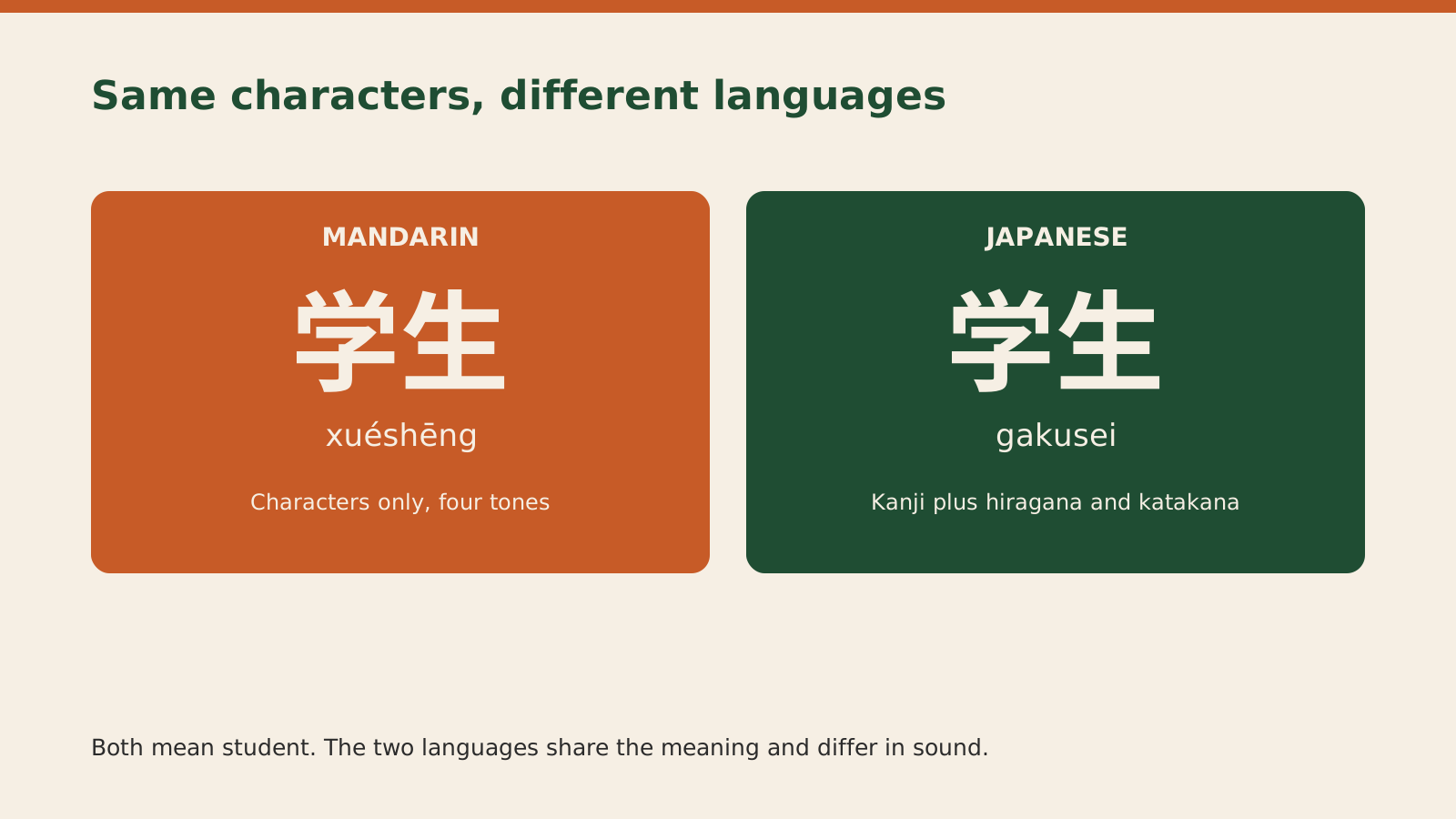
Japanese kanji came from China, and many common words are written with the same characters in both languages. 学生 means student in both, read xuéshēng in Mandarin and gakusei in Japanese. The meaning travels well. The sound does not. Telephone follows the same pattern: 電話 is denwa in Japanese, while Mandarin writes 电话 in simplified characters and reads it diànhuà. A learner of one language can often guess the meaning of the other’s written word and still have no idea how to say it.
| Point | Mandarin Chinese | Japanese |
|---|---|---|
| Characters for daily reading | 3,500 in the first tier of China’s 2013 standard list | 2,136 on the Jōyō kanji list |
| Simplified forms | Simplified in mainland China and Singapore, traditional in Taiwan, Hong Kong and Macau | Japan’s own simplified forms, different from mainland China’s |
| Readings per character | Usually one reading | Often two or more: a Chinese based reading and a native Japanese one |
| Example: “air, spirit” | 气 (simplified), 氣 (traditional) | 気 |
Multiple readings are the hardest part of Japanese kanji. The character 生 has several readings depending on the word, including sei, shō, i and nama. In Mandarin, 生 is almost always shēng.
How do the Chinese and Japanese writing systems compare?
Mandarin uses one writing system, characters, while Japanese uses three at once. A single Japanese sentence usually mixes all of them.
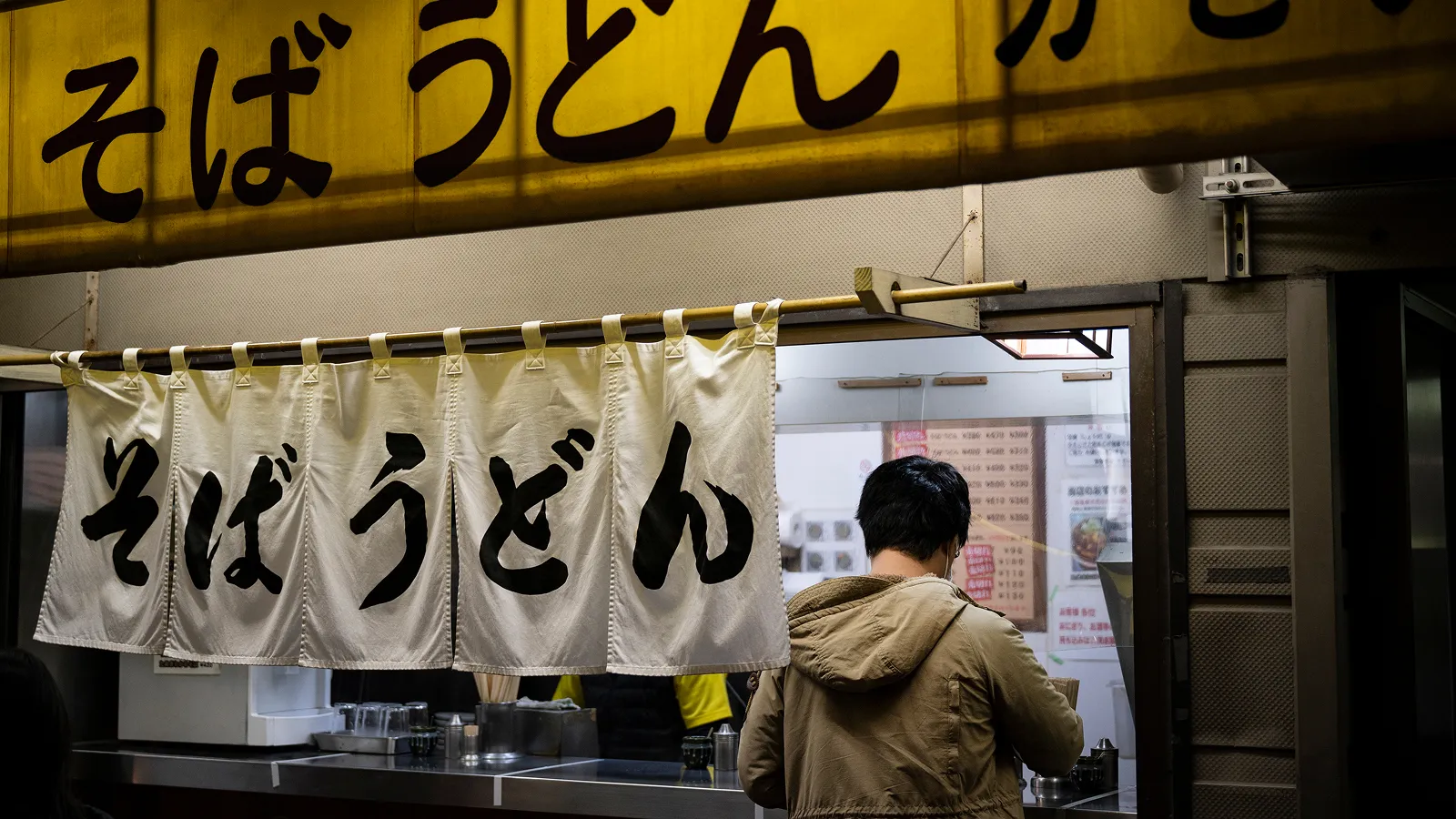
Japanese uses kanji for the core meaning of most nouns and verbs, hiragana for grammar endings and particles, and katakana for foreign loanwords and emphasis. Hiragana and katakana each have 46 basic symbols that represent sounds, and most beginners learn both within a few weeks. Our beginner’s guide to the three Japanese writing systems shows how they fit together.
Mandarin learners usually start with pinyin, a system that writes Mandarin sounds and tones in the Latin alphabet. Pinyin is a learning tool and a typing method. Books, signs and newspapers are written in characters.
The practical result: a Japanese beginner can read and write simple sentences in kana within a month, before learning many kanji. A Mandarin beginner reads characters from the start, so early reading moves more slowly.
How is pronunciation different in Chinese and Japanese?
Japanese pronunciation is generally quicker for English speakers to learn, while Mandarin pronunciation is one of the harder parts of the language. Tones are the reason.
Mandarin has four tones plus a neutral tone, and the tone is part of the word. Mā (high and level) means mother, mǎ (dipping) means horse, and mà (falling) means to scold. Mandarin also has several sounds, such as zh, x and q, that do not exist in English.
Japanese has five vowels and builds most syllables from one consonant plus one vowel, which keeps pronunciation predictable. It does use a pitch accent, so a few words differ by pitch, such as hashi for bridge and hashi for chopsticks. Context almost always resolves these, and pitch errors rarely block understanding the way tone errors do in Mandarin.
How is Chinese grammar different from Japanese grammar?
Mandarin grammar is lighter on forms, while Japanese grammar is heavier on endings and politeness. Each is quick in some areas and slow in others.
Mandarin verbs never change form. 我吃 (wǒ chī) means I eat, and 他吃 (tā chī) means he eats. Time is shown with words like yesterday or with small particles such as 了 (le), and the verb itself stays the same. Mandarin does require measure words between a number and a noun, as in 三本书 (sān běn shū), three books. Our Chinese for beginners guide covers these basics.
Japanese puts the verb at the end and marks the role of each noun with a particle. 私は寿司を食べます (watashi wa sushi o tabemasu) means I eat sushi, literally “I sushi eat”. Verbs change for past, negative and polite forms, and the polite masu form is what beginners learn first. Our Japanese for beginners guide explains the particles in order.
Chinese vs Japanese vs Korean: how do all three compare?
Mandarin, Japanese and Korean are all rated at about 2,200 class hours by the US Foreign Service Institute, but each puts its difficulty in a different place. Korean has the fastest script to learn, Japanese has the most scripts, and Mandarin has the hardest pronunciation.
| Feature | Mandarin Chinese | Japanese | Korean |
|---|---|---|---|
| Writing system | Chinese characters | Kanji, hiragana, katakana | Hangul, a 24 letter alphabet |
| Time to read basic text | Months | Weeks for kana, years for kanji | About one week |
| Tones | Four tones | No, pitch accent only | No, in standard Seoul Korean |
| Word order | Subject, verb, object | Subject, object, verb | Subject, object, verb |
| Particles after nouns | Few | Yes | Yes |
| Verb endings | None for tense or person | Tense, negation, politeness | Tense, negation, politeness |
| Chinese loanwords | Native vocabulary | Many, written in kanji | Many, written in Hangul |
| FSI estimate | 2,200 hours | 2,200 hours | 2,200 hours |
Japanese and Korean resemble each other in grammar, since both place the verb last and use particles. Korean and Japanese both borrowed heavily from Chinese, so a learner of any one of the three recognizes some vocabulary in the other two.
What do people get wrong about Chinese and Japanese?
Several common beliefs about these two languages do not survive a first lesson.
| Common belief | What is actually true |
|---|---|
| Japanese is a form of Chinese | They belong to different language families with unrelated grammar |
| If you read Chinese, you can read Japanese | You will recognize many kanji meanings, but kana, grammar and readings are new |
| Japanese has tones like Mandarin | Japanese has a pitch accent that rarely changes meaning in practice |
| Mandarin has no grammar | It has strict word order, aspect particles and measure words |
| Korean is written in Chinese characters | Modern Korean is written almost entirely in Hangul |
Should you learn Chinese or Japanese first?
Choose based on your goal and the skill you want first, since the total time is about the same. Japanese usually gets learners speaking and reading simple text sooner. Mandarin has simpler grammar but harder pronunciation.
| If you want to | Start with | Why |
|---|---|---|
| Speak clearly in the first months | Japanese | No tones and a small sound system |
| Avoid verb conjugation | Mandarin | Verbs never change form |
| Read simple text quickly | Japanese | Kana can be learned in weeks |
| Reach the most native speakers | Mandarin | More native speakers than any other language |
| Follow anime, games or Japanese media | Japanese | Direct access to the source |
| Learn the other language later | Either | Kanji and Chinese characters overlap in meaning |
Mandarin has more native speakers than any other language, and the Instituto Cervantes 2025 yearbook ranks it first by native speakers worldwide. Japanese is the language of about 123 million people in Japan and of a large share of the world’s animation, games and technology media.
LanguageBird teaches both Mandarin and Japanese in live one to one classes with native level instructors, so the lesson format stays the same whichever language a student picks.
I spent 20 years living in China and Japan, where I taught English and taught myself both the spoken and written forms of these languages.
Irene S, Japanese & Mandarin Instructor at LanguageBird
Frequently Asked Questions About Chinese vs Japanese
Are Chinese and Japanese the same language?
No. Mandarin belongs to the Sino Tibetan family and Japanese to the Japonic family, so their grammar and core vocabulary are unrelated. Japanese borrowed Chinese characters and thousands of words over many centuries, which is why the written languages look similar. A speaker of one cannot understand spoken conversation in the other without study.
Can Chinese speakers read Japanese?
Partly. A Chinese reader recognizes the meaning of many kanji, so they can often guess the topic of a Japanese sign or headline. They cannot read the hiragana and katakana that carry Japanese grammar, and they do not know the Japanese readings of the characters. Full reading still requires learning Japanese grammar and kana.
Which is harder to learn, Chinese or Japanese?
The US Foreign Service Institute rates both at about 2,200 class hours for English speakers, so the total effort is similar. Mandarin is harder in pronunciation because of its four tones. Japanese is harder in reading, because it uses three scripts and most kanji have several readings. Mandarin grammar is simpler than Japanese grammar.
Do Japanese and Chinese characters mean the same thing?
Often, but not always. Many characters share their core meaning, such as 学生 for student in both languages. Some characters have shifted meaning over time, and Japan and mainland China simplified many characters in different ways, so the same word can look slightly different. Pronunciation is almost always different between the two languages.
How is Korean different from Chinese and Japanese?
Korean uses Hangul, a 24 letter alphabet that most learners read within a week. Like Japanese, it puts the verb at the end and marks nouns with particles. Like Japanese, it borrowed many words from Chinese. Unlike Mandarin, standard Korean has no tones. All three are rated at about 2,200 class hours.
Should I learn Mandarin or Japanese for my career?
Mandarin connects learners to the world’s largest community of native speakers and to China’s role in trade, manufacturing and technology. Japanese is valuable in technology, engineering, design, gaming and media. Both are rare skills among US students. The best choice is usually the language you will keep studying, since both take years.
Can high school students take Mandarin or Japanese for credit online?
Yes. Students whose school does not offer Mandarin or Japanese, or offers only one of them, can take the course through an accredited online school and transfer the credit with a counselor’s approval. LanguageBird offers accredited middle and high school credit in both languages through live one to one classes with native level instructors. The high school course catalog lists the Mandarin and Japanese courses.
Start Mandarin or Japanese With a Live Instructor
Tones in Mandarin and particles in Japanese both settle faster when someone hears you and corrects you on the spot. That feedback matters most in the first year, while habits are still forming.
LanguageBird offers live one to one classes with native level instructors in more than a dozen languages. Students can earn accredited middle and high school credit, and our A to G approved courses count toward University of California admission requirements. Explore the Mandarin program and the Japanese program, or browse the high school course catalog.
Sources
- US Department of State, Foreign Service Institute: Foreign Language Training
- Instituto Cervantes, El español en el mundo 2025 (yearbook)
- State Council of China, Table of General Standard Chinese Characters (2013)