
 Sign In


Every statistic in this article was checked against its original source on October 21, 2026.
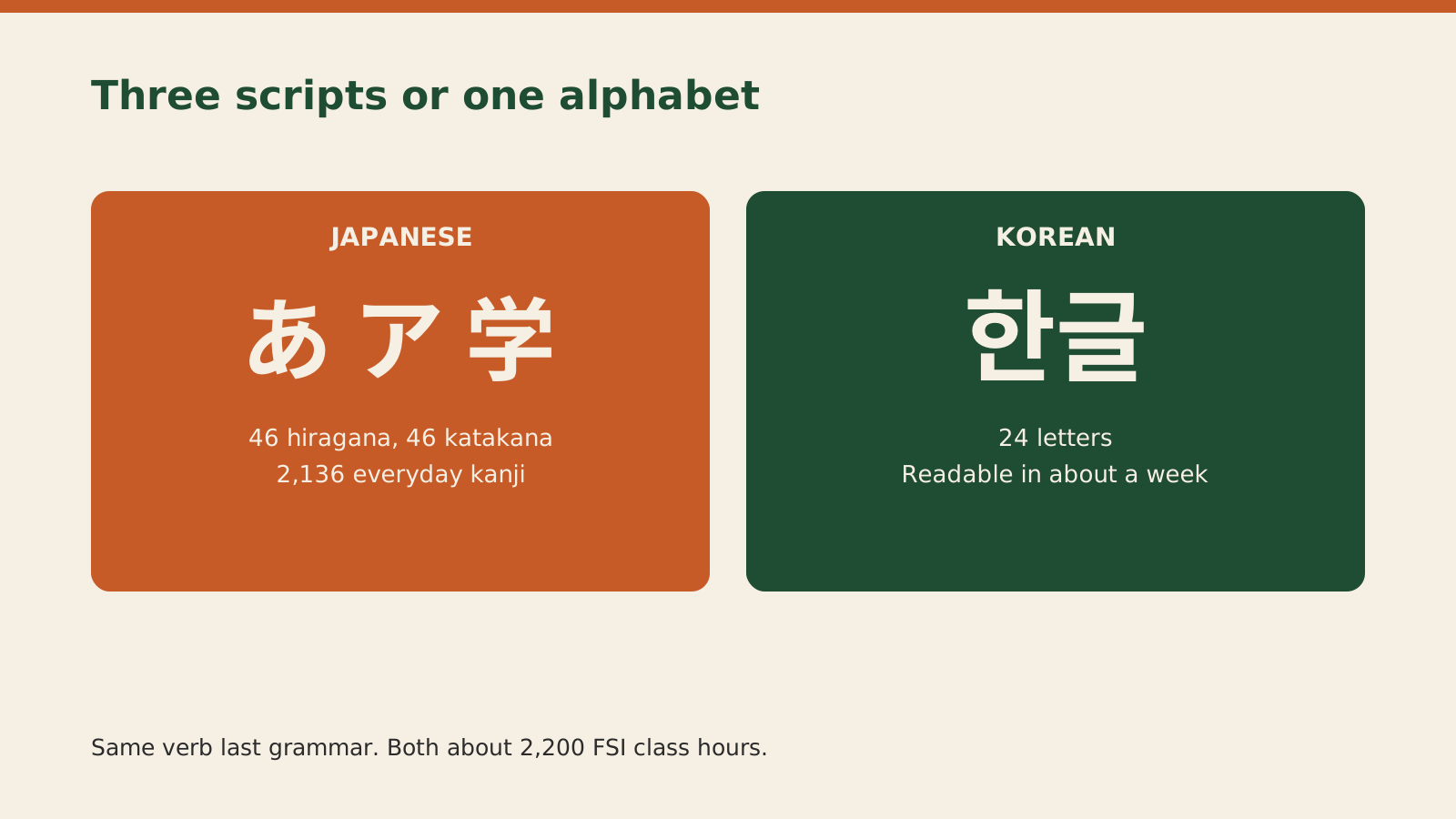
Japanese and Korean have strikingly similar grammar, yet they are written in completely different ways. Both put the verb at the end and mark nouns with small particles, but Korean uses one 24 letter alphabet, while Japanese uses three scripts at once.
The Japanese vs Korean decision usually comes down to two questions: which script you want to tackle, and which culture pulls you in. This guide compares the writing, sounds, grammar and vocabulary side by side. For live one to one classes, see the LanguageBird Japanese program and the Korean program.
Quick Answer
Japanese and Korean both use subject, object, verb order, mark nouns with particles and build politeness into verb endings. The US Foreign Service Institute rates both at about 2,200 class hours for English speakers. Korean reading starts faster because Hangul has 24 letters, while Japanese pronunciation is simpler.
Key Takeaways
- Both languages are rated at 88 weeks, or about 2,200 class hours, by the US Foreign Service Institute.
- Korean is written in Hangul, a 24 letter alphabet that most learners read within about a week.
- Japanese uses hiragana and katakana, with 46 basic symbols each, plus 2,136 everyday kanji on the official Jōyō list.
- Japanese has five vowel sounds, while Korean has more vowels and a three way contrast among consonants such as g, k and kk.
- Both languages borrowed heavily from Chinese, so words like library sound related: toshokan in Japanese and doseogwan in Korean.
What is the difference between Japanese and Korean?
The biggest difference is the writing system. Korean uses one phonetic alphabet, while Japanese mixes two phonetic scripts with Chinese characters. Grammar, on the other hand, is strikingly similar.
| Feature | Japanese | Korean |
|---|---|---|
| Writing | Hiragana, katakana and kanji | Hangul, a 24 letter alphabet |
| Time to read simple text | A few weeks for kana, years for kanji | About one week |
| Vowel sounds | Five | More than five, with some close pairs |
| Consonant contrasts | Mostly familiar to English speakers | Plain, aspirated and tense series |
| Word order | Subject, object, verb | Subject, object, verb |
| Particles | wa, ga, o, ni and others | eun or neun, i or ga, eul or reul and others |
| Politeness in verbs | Plain and polite forms, plus honorifics | Several speech levels, plus honorifics |
| FSI estimate | 88 weeks, about 2,200 hours | 88 weeks, about 2,200 hours |
How do Japanese and Korean writing systems compare?
Korean writing is faster to learn, while Japanese writing takes far longer to master. That single difference shapes the first year of study more than anything else.
Hangul was created under King Sejong and promulgated in 1446 so that ordinary people could read. Its 14 basic consonants and 10 basic vowels combine into syllable blocks, so 한 is h plus a plus n. Most learners read slowly within a week. Our guide to Korean alphabet basics walks through the letters.
Japanese learners start with hiragana and katakana, two sets of 46 basic sound symbols, which take a few weeks. Then come kanji, the Chinese characters. The Japanese government’s Jōyō list of everyday kanji contains 2,136 characters, and most have more than one reading. That is why Japanese reading is a multi year project, as our article on whether Japanese is hard to learn explains.
How is pronunciation different in Japanese and Korean?
Japanese pronunciation is generally quicker for English speakers, while Korean pronunciation takes more practice. Neither language uses Mandarin style tones in its standard form.
Japanese has five vowels and builds most syllables from a consonant plus a vowel, so words are predictable once you know the kana. Korean has more vowels, including pairs that English speakers struggle to separate, and a three way contrast among many consonants. The letters ㄱ, ㅋ and ㄲ are plain, breathy and tense versions of a g or k sound, and switching them can change the word.
Korean also changes the sound of letters when they meet across syllables. 한국어, the word for the Korean language, is written han guk eo but pronounced hangugeo. These rules are regular, and learners absorb them fastest by listening and repeating with a teacher.
How similar are Japanese and Korean grammar?
Japanese and Korean grammar are very similar, which is why learning one shortens the road to the other. Both place the verb last, mark each noun’s role with a particle, and change verb endings for tense, negation and politeness.
| English | Japanese | Korean |
|---|---|---|
| I eat rice. | 私はご飯を食べます (watashi wa gohan o tabemasu) | 저는 밥을 먹어요 (jeoneun babeul meogeoyo) |
| Word order | I, rice, eat | I, rice, eat |
| Topic particle | wa | neun |
| Object particle | o | eul |
| Polite ending | masu | yo |
Korean particles have two forms depending on whether the noun ends in a consonant or a vowel, which adds one small rule Japanese does not have. Korean also has more speech levels for politeness. Japanese has its own complex honorific system, called keigo, which learners meet in more formal settings.
Do Japanese and Korean share vocabulary?
Japanese and Korean share many words, and most of them arrived the same way: both languages borrowed heavily from Chinese. These related words often sound similar once you know the pattern.
| English | Japanese | Korean | Shared Chinese characters (traditional forms) |
|---|---|---|---|
| student | gakusei | haksaeng | 學生 |
| university | daigaku | daehak | 大學 |
| library | toshokan | doseogwan | 圖書館 |
| telephone | denwa | jeonhwa | 電話 |
A learner who knows one language will start spotting these pairs in the other within weeks. For the three way comparison with Mandarin, see our guide to Chinese vs Japanese, which includes a table covering all three languages.
How does pop culture affect learning Japanese or Korean?
Interest in anime, manga, games, K pop and Korean drama brings many students to these languages, and that motivation helps them keep going through the hard middle years. The trend shows up in enrollment data.
The Modern Language Association’s census of US college language enrollments, published in 2023, found that Korean enrollments rose 38.3 percent between fall 2016 and fall 2021, during a period when most languages declined. Japanese remains one of the most studied Asian languages in US colleges, supported by decades of interest in anime and games.
Pop culture works best as listening practice. Song lyrics and drama dialogue often use casual or dramatic speech that sounds odd in real conversation, so learners still need a teacher to show which forms suit which situation.
My Japanese is standard and has no dialect. I keep up with popular words, including slang, through my teenage niece and my Japanese friends who live in Japan.
Sayuri S, Japanese Instructor at LanguageBird

What do people get wrong about Japanese and Korean?
A few beliefs about these two languages lead learners to the wrong choice.
| Common belief | What is actually true |
|---|---|
| Japanese and Korean are dialects of the same language | They are separate languages, and linguists still debate whether they are related at all |
| Korean is written with Chinese characters | Modern Korean is written almost entirely in Hangul |
| Fast reading means a fast language | Hangul is quick, but Korean pronunciation and speech levels take years |
| Japanese grammar is the hardest part | Kanji takes longer than grammar for most Japanese learners |
| You can learn either one from dramas or anime alone | Media builds listening, but speaking needs practice and correction |
Should you learn Japanese or Korean first?
Pick the language whose culture, people or career path you care about most, since both take about the same total time. If you are torn, the table can break the tie.
| If you want to | Start with | Why |
|---|---|---|
| Read real text in the first month | Korean | Hangul takes about a week |
| Pronounce words clearly early | Japanese | Five vowels and simple syllables |
| Follow anime, manga or games | Japanese | Direct access to the source |
| Follow K pop or Korean drama | Korean | Direct access to the source |
| Learn the other language later | Either | Shared grammar carries over |
LanguageBird teaches both Japanese and Korean in live one to one classes with native level instructors, so a student can start with either one and add the other later.
Frequently Asked Questions About Japanese vs Korean
Is Japanese or Korean easier to learn?
Neither is quick: the US Foreign Service Institute rates both at about 2,200 class hours for English speakers. Korean moves faster at the start because Hangul takes about a week to read. Japanese pronunciation is simpler, but kanji make reading a long project. The overall effort is similar, so motivation usually decides.
Is Korean easy to learn for English speakers?
Korean is quick to start and slow to master. Hangul takes about a week, which gives learners early wins. After that, Korean pronunciation, speech levels and verb endings take years, and the US Foreign Service Institute places Korean in its longest category, at 88 weeks or about 2,200 class hours of full time study.
Are Japanese and Korean similar?
Their grammar is very similar. Both put the verb last, use particles after nouns and change verb endings for politeness. Their writing systems are completely different, and their sounds differ too. Both borrowed many words from Chinese, so pairs like daigaku and daehak, both meaning university, sound related.
Can a Japanese speaker learn Korean faster?
Yes. Japanese speakers already think in subject, object, verb order, use particles and recognize much of the Chinese based vocabulary, so Korean grammar feels familiar. The main new work is Hangul, Korean pronunciation and the speech levels. The same head start works in the other direction for Korean speakers learning Japanese.
Which is more useful, Japanese or Korean?
Both are valuable and uncommon among US students. Japan is one of the largest economies in the world and a center for technology, engineering, design and games. South Korea leads in electronics, shipbuilding and entertainment. The most useful choice is usually the language you will keep studying for several years.
Can I learn Japanese and Korean at the same time?
It is possible but slow for beginners, because the similar grammar makes learners mix up particles and endings. Most teachers suggest reaching a solid conversational level in one first. After that, the shared grammar and Chinese based vocabulary make the second language move noticeably faster.
Can high school students take Japanese or Korean for credit online?
Yes. If a school does not offer Japanese or Korean, a student can take either language through an accredited online school and transfer the credit once a counselor approves it. LanguageBird offers accredited middle and high school credit in both languages through live one to one classes with native level instructors, and the high school course catalog lists the Japanese and Korean courses.
Start Japanese or Korean With a Live Instructor
Kanji and Hangul get most of the attention, but what decides progress is speaking practice: particles in the right place, the right speech level, and sounds that a native speaker recognizes. That improves fastest with someone listening.
LanguageBird offers live one to one classes with native level instructors in more than a dozen languages. Students can earn accredited middle and high school credit, and our A to G approved courses count toward University of California admission requirements. Explore the Japanese program and the Korean program, or browse the high school course catalog.