
 Sign In


Every statistic in this article was checked against its original source on October 21, 2026.
The Spanish food terms beginners need first are the words for meals, a few staple ingredients and the phrases to order and pay. With desayuno, comida, cena, agua and la cuenta, por favor, you can already get through a day of eating in Spanish.
Spanish food terms also change from country to country more than most vocabulary. A potato is a papa in Mexico and a patata in Spain, and beans have at least five names. This guide groups the words by category and names the country for every regional word. For conversation practice, visit the LanguageBird Spanish program.
Quick Answer
The ten Spanish food words to learn first are el desayuno (breakfast), la comida (lunch or food), la cena (dinner), el agua (water), el pan (bread), la carne (meat), el pollo (chicken), el pescado (fish), las verduras (vegetables) and la fruta (fruit). To pay, say la cuenta, por favor.
Key Takeaways
- The main meals are el desayuno, la comida or el almuerzo, and la cena, and their timing varies by country.
- Many food words change by region: avocado is aguacate in Mexico and palta in Argentina, Chile and Peru.
- Quisiera, meaning “I would like”, is the polite way to order in any Spanish speaking country.
- Spanish uses tener for hunger and thirst: tengo hambre means “I am hungry”.
- The same word can name different foods: a tortilla is a flatbread in Mexico and a potato omelette in Spain.
What Spanish food terms should beginners learn first?
Start with meal names and the most common foods, because they come up every day. Learn each noun with its article, since the article shows whether the word is masculine or feminine.
| Spanish | English | Spanish | English |
|---|---|---|---|
| el desayuno | breakfast | el pan | bread |
| la comida | lunch, or food in general | la carne | meat |
| el almuerzo | lunch | el pollo | chicken |
| la cena | dinner | el pescado | fish |
| la merienda | afternoon snack | las verduras | vegetables |
| el agua | water | la fruta | fruit |
El agua is feminine even though it takes el. Spanish uses el before feminine nouns that start with a stressed a sound, so the plural is las aguas.
What are the Spanish words for meals and mealtimes?
Spanish has the same three main meals as English, but the names and times shift by country. Knowing local habits helps you understand when people say “let’s eat”.
| Meal | Common word | Regional notes |
|---|---|---|
| Breakfast | el desayuno | Used everywhere |
| Lunch | la comida | The main meal of the day in Mexico, usually in the afternoon |
| Lunch | el almuerzo | Common in much of Latin America. In Spain, almuerzo can mean a midmorning snack |
| Afternoon snack | la merienda | Common in Spain, Argentina and Uruguay |
| Dinner | la cena | Used everywhere. In Spain, dinner is often eaten late in the evening |
What are the Spanish words for common ingredients?
These ingredients appear on menus, in recipes and in grocery stores across the Spanish speaking world. They are grouped so you can learn them in sets.
| Proteins | Vegetables | Fruits | Dairy and staples |
|---|---|---|---|
| la carne de res (beef) | la lechuga (lettuce) | la manzana (apple) | la leche (milk) |
| el cerdo (pork) | el tomate (tomato) | la naranja (orange) | el queso (cheese) |
| el pollo (chicken) | la cebolla (onion) | el limón (lemon or lime) | la mantequilla (butter) |
| el pescado (fish) | el ajo (garlic) | la uva (grape) | el arroz (rice) |
| el huevo (egg) | la zanahoria (carrot) | la sandía (watermelon) | el azúcar (sugar) |
Notice pescado and pez. Pescado is fish as food, while pez is a live fish swimming in water.
What are the Spanish words for drinks?
Drinks are some of the first words travelers use, and a few of them vary by region.
| Spanish | English | Notes |
|---|---|---|
| el agua | water | Agua con gas is sparkling, agua sin gas is still |
| el jugo | juice | Latin America |
| el zumo | juice | Spain |
| el café | coffee | Café con leche is coffee with milk |
| el té | tea | Used everywhere |
| el refresco | soda | Used widely. You will also hear gaseosa in Colombia, Peru and Argentina |
| la leche | milk | Used everywhere |
We’ll also explore culture along the way. For example: Do you know what tango is? Or what mate is?
Gimena M, Spanish Instructor at LanguageBird
How do you order food in Spanish?
Order with quisiera or me trae, and finish with por favor. These phrases are polite in every Spanish speaking country and work in cafés, restaurants and food stalls.
| Spanish | English |
|---|---|
| Una mesa para dos, por favor. | A table for two, please. |
| ¿Me trae la carta, por favor? | Could you bring me the menu, please? |
| ¿Qué me recomienda? | What do you recommend? |
| Quisiera el pollo con arroz. | I would like the chicken with rice. |
| Para mí, una ensalada. | A salad for me. |
| Sin cebolla, por favor. | No onion, please. |
| Soy alérgico al maní. | I am allergic to peanuts. |
| ¿Está incluida la propina? | Is the tip included? |
| La cuenta, por favor. | The check, please. |
Both pedir and ordenar mean “to order”. Pedir works everywhere, while ordenar is especially common in Mexico. If you need a waiter’s attention, a simple perdón or disculpe is polite.

Which Spanish food words change by country?
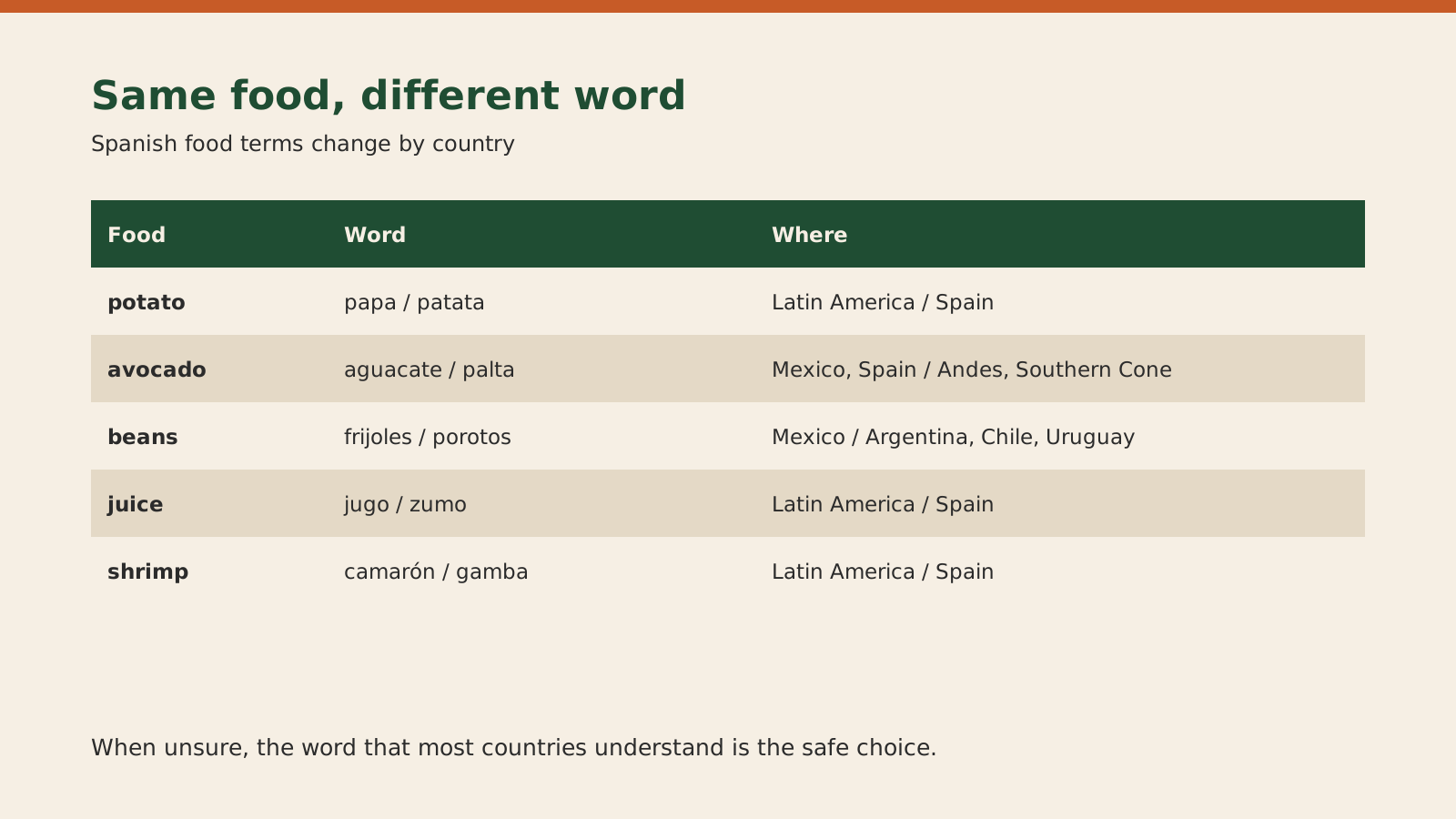
Many everyday foods have different names depending on the country. Here are the ones you will hear most, with the places they are used.
| English | Word | Where it is used |
|---|---|---|
| potato | papa | Latin America and the Canary Islands |
| potato | patata | Spain |
| beans | frijoles | Mexico and Central America |
| beans | porotos | Argentina, Chile and Uruguay |
| beans | caraotas | Venezuela |
| beans | habichuelas | Puerto Rico and the Dominican Republic |
| beans | alubias or judías | Spain |
| avocado | aguacate | Mexico, Central America, Colombia and Spain |
| avocado | palta | Argentina, Chile, Peru and Uruguay |
| strawberry | frutilla | Argentina, Chile and Uruguay |
| corn on the cob | elote | Mexico and Central America |
| corn on the cob | choclo | Peru, Chile, Ecuador and Argentina |
| peach | durazno | Most of Latin America |
| peach | melocotón | Spain |
| shrimp | camarón | Latin America |
| shrimp | gamba | Spain |
| waiter | mesero | Mexico, Colombia and Central America |
| waiter | camarero | Spain |
| waiter | mozo | Argentina and Uruguay |
The wider word for strawberry, fresa, is understood everywhere, which makes it the safe choice when you are unsure. Our guide to Spanish speaking countries shows where each of these regions sits on the map.
Which Spanish food words mean different things in different countries?
A few words name completely different foods depending on where you are. These cause real confusion at the table.
| Word | In Mexico | In Spain | Elsewhere |
|---|---|---|---|
| tortilla | Corn or flour flatbread | Potato and egg omelette | Varies by country |
| torta | Sandwich on a roll | Flat cake or pastry | Cake in Argentina and Chile |
| bocadillo | A small snack or appetizer | Sandwich on a baguette roll | Guava paste sweet in Colombia |
| plátano | Banana | Banana | Often plantain in the Caribbean |
Slang around food also varies. Our list of Mexican Spanish slang includes several food expressions you will hear in Mexico.
What food mistakes do English speakers make in Spanish?
Most food mistakes come from translating English word for word. These are the ones teachers correct most often.
| Common mistake | What to say instead | Why |
|---|---|---|
| Estoy hambre | Tengo hambre | Spanish uses tener for hunger and thirst |
| Soy lleno | Estoy lleno | Being full is a temporary state, so it takes estar |
| Quiero el cheque | La cuenta, por favor | The restaurant bill is la cuenta |
| Me gusta los tacos | Me gustan los tacos | Gustar agrees with the plural food |
| El pez está delicioso | El pescado está delicioso | Pescado is fish as food |
How can you practice Spanish food vocabulary?
Food words stick fastest when you use them in real situations instead of studying them as a list. Three habits help most.
- Read menus from restaurants in Mexico, Spain or Argentina online and translate the dishes.
- Label foods in your kitchen with their Spanish names and articles.
- Practice ordering out loud, including allergies and special requests.
Grocery shopping is another good practice ground, as our tips for grocery shopping in a foreign language explain. With Spanish official in 21 countries and the Instituto Cervantes 2025 yearbook counting about 635 million people who can use it, food vocabulary is some of the most portable you will learn. In our Spanish program, live one to one classes with native level instructors give students a place to practice ordering out loud.
Frequently Asked Questions About Spanish Food Terms
What are the most basic Spanish food words?
Start with the meals and staples: el desayuno (breakfast), la comida (lunch or food), la cena (dinner), el agua (water), el pan (bread), la carne (meat), el pollo (chicken), el pescado (fish), las verduras (vegetables) and la fruta (fruit). Add la cuenta, por favor to ask for the check, and you can handle most meals.
How do you order food politely in Spanish?
Use quisiera, which means “I would like”, followed by the dish and por favor. For example, quisiera el pollo con arroz, por favor. You can also say ¿me trae…? to ask the server to bring something. Both forms are polite in every Spanish speaking country, from Mexico to Spain to Argentina.
Why are there different Spanish words for the same food?
Spanish is spoken in 21 countries, and food words developed locally, often influenced by indigenous languages. Aguacate and elote come from Nahuatl, the language of the Aztecs, while palta and choclo come from Quechua, spoken in the Andes. That is why avocado and corn have different names in Mexico and Peru.
What is the difference between tortilla in Mexico and Spain?
In Mexico, a tortilla is a thin flatbread made from corn or wheat flour, used for tacos and quesadillas. In Spain, a tortilla, often called tortilla española, is a thick omelette made with potatoes, eggs and often onion. Both are everyday foods, so asking for a tortilla gets a very different plate in each country.
How do you say “I am hungry” in Spanish?
Say tengo hambre, which literally means “I have hunger”. Spanish uses tener for hunger and thirst, so “I am thirsty” is tengo sed. Saying estoy hambre is a common beginner mistake. To say you are very hungry, use tengo mucha hambre, since hambre is a feminine noun.
What does la cuenta mean in Spanish?
La cuenta means the check or the bill in a restaurant. To ask for it, say la cuenta, por favor. In many Spanish speaking countries, servers do not bring the check until you ask, because rushing diners is considered rude. Ask whether the tip is included with ¿está incluida la propina?
Can you take Spanish for credit outside your own school?
Yes. Students can take a world language through an accredited online school when their own school does not offer the level or schedule they need. The credit transfers once a counselor approves it, so ask before enrolling. LanguageBird offers accredited middle and high school credit through live one to one classes with native level instructors, and the high school course catalog lists the Spanish courses.
Practice Spanish Food Talk With a Live Instructor
Ordering in a real café is different from reading a vocabulary table: the server talks fast, the menu uses local words, and you need the right phrase in a few seconds. Practicing those moments out loud is what makes them feel routine later.
LanguageBird offers live one to one classes with native level instructors in more than a dozen languages. Students can earn accredited middle and high school credit, and our A to G approved courses count toward University of California admission requirements. Explore the Spanish program or browse the high school course catalog.
Sources
- Instituto Cervantes, El español en el mundo 2025 (yearbook)