
 Sign In


Every statistic in this article was checked against its original source on October 21, 2026.
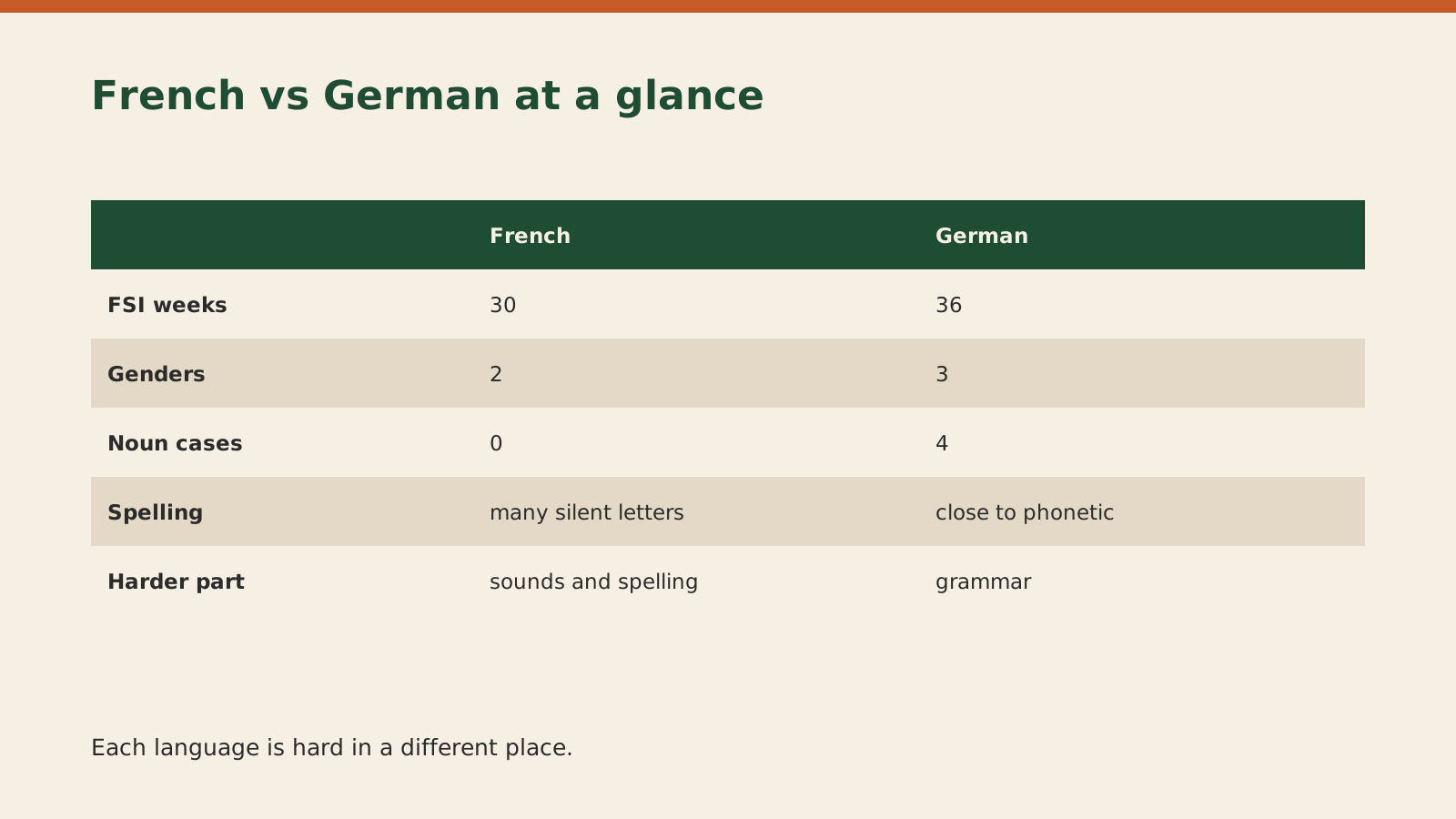
French usually takes English speakers less time than German: the US Foreign Service Institute estimates 30 weeks of study for French and 36 for German. German grammar is harder, with four cases and strict word order, while French pronunciation and spelling are harder, with silent letters and nasal vowels.
The French vs German decision is one many high school students face, since both are common school languages with strong college and career value. This guide compares them fairly on difficulty, grammar, sound and usefulness. For live one to one classes, see the LanguageBird French program and the German program.
Quick Answer
French takes about 30 weeks of full time study for English speakers and German about 36, according to the US Foreign Service Institute. German grammar is harder because of four cases and verb placement rules. French pronunciation and spelling are harder because of silent letters, nasal vowels and linked words.
Key Takeaways
- The Foreign Service Institute estimates 30 weeks, about 750 class hours, for French and 36 weeks, about 900 hours, for German.
- German has four grammatical cases and three genders, while French has two genders and no noun cases.
- German spelling is close to phonetic, while French spelling includes many silent letters.
- English is a Germanic language, yet a 1973 study by Finkenstaedt and Wolff traced about 28 percent of English words to French.
- The OIF’s 2026 report counts 396 million French speakers worldwide.
Does French or German take longer for English speakers?
German takes longer in total, but neither language is uniformly simpler: each is hard in a different area. The Foreign Service Institute places French in Category I and German in Category II.
| Feature | French | German |
|---|---|---|
| FSI estimate | 30 weeks, about 750 class hours | 36 weeks, about 900 class hours |
| Language family | Romance | Germanic, like English |
| Genders | Two: masculine and feminine | Three: masculine, feminine and neuter |
| Noun cases | None | Four: nominative, accusative, dative and genitive |
| Word order | Mostly like English | Verb in second place, and at the end of subordinate clauses |
| Spelling and sound | Many silent letters | Close to phonetic |
| Pronunciation challenge | Nasal vowels, the French r, linked words | Umlauts, the ch sound, long compound words |
| Vocabulary overlap with English | Large, through Norman French | Large in basic words, through shared Germanic roots |
Our guides to whether French is hard to learn and whether German is hard to learn cover each language in more depth.
How is German grammar different from French grammar?
German grammar has more forms to manage, while French grammar has more irregular verbs and tenses. Most learners find German grammar slower at first and French grammar trickier later.
German nouns change their articles across four cases, depending on their role in the sentence. Der Hund (the dog) becomes den Hund as a direct object and dem Hund after many prepositions. German also places the conjugated verb second in a main clause and sends it to the end in a subordinate clause, so learners must plan the whole sentence before speaking.
French has no noun cases, and its word order is close to English. Its challenges sit in the verbs: many common verbs are irregular, the past tense requires choosing between avoir and être, and the subjunctive appears in everyday speech.
| Example | French | German |
|---|---|---|
| The dog sees the cat. | Le chien voit le chat. | Der Hund sieht die Katze. |
| I know that he is coming. | Je sais qu’il vient. | Ich weiß, dass er kommt. |
| I went to school. | Je suis allé à l’école. | Ich bin zur Schule gegangen. |
In the second German sentence, kommt moves to the end. In the third, the participle gegangen ends the sentence. These patterns feel unusual at first and become automatic with practice.
Which has harder pronunciation, French or German?
French pronunciation is harder for most English speakers, mainly because spelling and sound do not match. German pronunciation is more predictable once you learn its rules.
French drops many final letters, so the s, t and x at the end of words are often silent. It has nasal vowels, as in bon and vin, and it links words together in speech, so vous avez sounds like voozavay. Learners can often read French long before they can follow it spoken.
German spelling matches sound closely, so you can read a new word aloud correctly. Its challenges are the umlauts ä, ö and ü, the ch sound in ich and Bach, and long compound words such as Geschwindigkeitsbegrenzung, which means speed limit. Our French for beginners guide covers French sounds step by step.
How do French and German relate to English?
English is a Germanic language with a heavy French layer. Its grammar and most basic words are Germanic, while much of its formal and academic vocabulary came from French after the Norman Conquest of 1066.
German helps with everyday words: Haus and house, Wasser and water, Buch and book, trinken and drink. French helps with longer, formal words: nation, information, government, justice and restaurant. In their 1973 study of English vocabulary, Thomas Finkenstaedt and Dieter Wolff traced about 28 percent of English words to French, a share similar to the words that came from Latin.
So English speakers get help from both languages, in different places. Basic German conversation often feels familiar, while French academic reading often feels familiar.
Which is more useful, French or German?
Both are useful, in different ways. French has a wider global reach, while German is concentrated in central Europe with a strong economy behind it.
| Factor | French | German |
|---|---|---|
| Speakers | 396 million, according to the OIF’s 2026 report | Concentrated in Germany, Austria, Switzerland and nearby countries |
| Where it is official | Countries in Europe, Africa, the Americas and the Pacific | Germany, Austria, Switzerland, Liechtenstein, Luxembourg and Belgium |
| International bodies | A working language of the United Nations and many international organizations | An official language of the European Union |
| Career strengths | Diplomacy, international development, fashion, food, hospitality | Engineering, manufacturing, science, automotive and research |
| Growth | Fast growth in Africa, where 65 percent of French speakers now live | Stable, with the largest economy in the European Union |
The OIF, the International Organisation of La Francophonie, reports that French is the second most taught foreign language in the world, after English. German remains one of the most valued languages in European science and industry.
Having worked with international companies and traveled to more than 30 countries, I understand how language opens doors to new opportunities and connections.
Josephine F, French & German Instructor at LanguageBird

What do people get wrong about French and German?
Several common beliefs make the choice harder than it needs to be.
| Common belief | What is actually true |
|---|---|
| German is much harder than French | The FSI gap is 6 weeks. German grammar is harder, but French pronunciation is harder |
| French is only useful in France | French is spoken across Europe, Africa, Canada and the Caribbean |
| German sounds harsh, so it is hard to speak | German pronunciation is regular once you learn a few rules |
| English speakers already know French vocabulary | Many formal words overlap, but everyday French still needs study |
| You must pick the useful language over the interesting one | Motivation predicts success more than any ranking |
Should you learn French or German?
Choose the language you are most likely to keep studying, since both reward several years of steady work. Use the table below if you are torn.
| If you want to | Choose | Why |
|---|---|---|
| Read and understand formal English words better | French | About 28 percent of English vocabulary came from French |
| Speak basic sentences with familiar words | German | Many everyday words share Germanic roots with English |
| Work in diplomacy or international development | French | Wide use in international organizations and Africa |
| Work in engineering, science or manufacturing | German | Strong demand in German speaking industries |
| Read new words aloud correctly from the start | German | Spelling matches sound closely |
| Avoid noun cases | French | No case endings on nouns |
LanguageBird teaches both French and German in live one to one classes with native level instructors, so a student can begin with either one. Many students who choose one end up adding the other later.
Frequently Asked Questions About French vs German
Is French or German easier for English speakers?
French takes slightly less time: the US Foreign Service Institute estimates 30 weeks for French and 36 weeks for German. The difficulty sits in different places. German grammar is harder because of four cases and verb placement. French pronunciation and spelling are harder because of silent letters, nasal vowels and words that link together in speech.
Should I learn French or German in high school?
Choose the language you will stay with for three or four years, since colleges value sustained study more than which language you pick. French suits students interested in international relations, travel or the arts. German suits students drawn to engineering, science or central Europe. Both carry strong college and career value.
Is German grammar harder than French grammar?
Yes, for most English speakers. German has four noun cases, three genders and strict rules for where the verb goes, including at the end of subordinate clauses. French has two genders and no noun cases, but it has many irregular verbs, a tricky past tense choice between avoir and être, and frequent use of the subjunctive.
Which language is more similar to English, French or German?
English grammar and basic vocabulary are Germanic, so everyday German words like Haus and Wasser feel familiar. English formal vocabulary is heavily French, and Finkenstaedt and Wolff’s 1973 study traced about 28 percent of English words to French. German helps more with basic conversation, while French helps more with academic reading.
Which is more useful for a career, French or German?
It depends on the field. French is valuable in diplomacy, international development, hospitality and work in Africa, where most of the 396 million French speakers counted by the OIF now live. German is valuable in engineering, manufacturing, automotive work and research, especially in Germany, which has the largest economy in the European Union.
Can I learn French and German at the same time?
You can, and it causes less confusion than learning two Romance languages together, because French and German are different enough that learners rarely mix them up. It still doubles the workload. Most students do best by reaching a solid level in one first, then adding the second once study habits are in place.
How many years of French or German do colleges expect?
The University of California requires two years of the same language other than English and recommends three. Other colleges set their own expectations, so check each admissions page, and pick one language early so those years fit in. LanguageBird offers A to G approved courses and accredited middle and high school credit through live one to one classes with native level instructors. See the high school course catalog.
Learn French or German With a Live Instructor
German cases and French sounds both improve fastest with someone who listens and corrects you as you speak. That feedback is the difference between knowing a rule and using it in real time.
LanguageBird offers live one to one classes with native level instructors in more than a dozen languages. Students can earn accredited middle and high school credit, and our A to G approved courses count toward University of California admission requirements. Explore the French program and the German program, or browse the high school course catalog.
Sources
- US Department of State, Foreign Service Institute: Foreign Language Training
- French Ministry for Europe and Foreign Affairs, International Francophonie Day 2026, citing the OIF report La langue française dans le monde
- Thomas Finkenstaedt and Dieter Wolff, Ordered Profusion (1973)
- University of California Admissions, Subject requirement A to G