
 Sign In


Every statistic in this article was checked against its original source on October 21, 2026.
To learn Spanish on your own, study 30 to 45 minutes a day with a fixed weekly routine: pronunciation and core verbs first, then the present tense, high frequency vocabulary, daily listening, and short speaking practice from the first week. Self study builds reading, listening and vocabulary well. Speaking and feedback are where it needs help.
This guide on how to learn Spanish on your own gives you a 12 week plan, the tools that fit each skill, and an honest look at where self study stalls. If you want live practice alongside it, the LanguageBird Spanish program pairs students with native level instructors.
Quick Answer
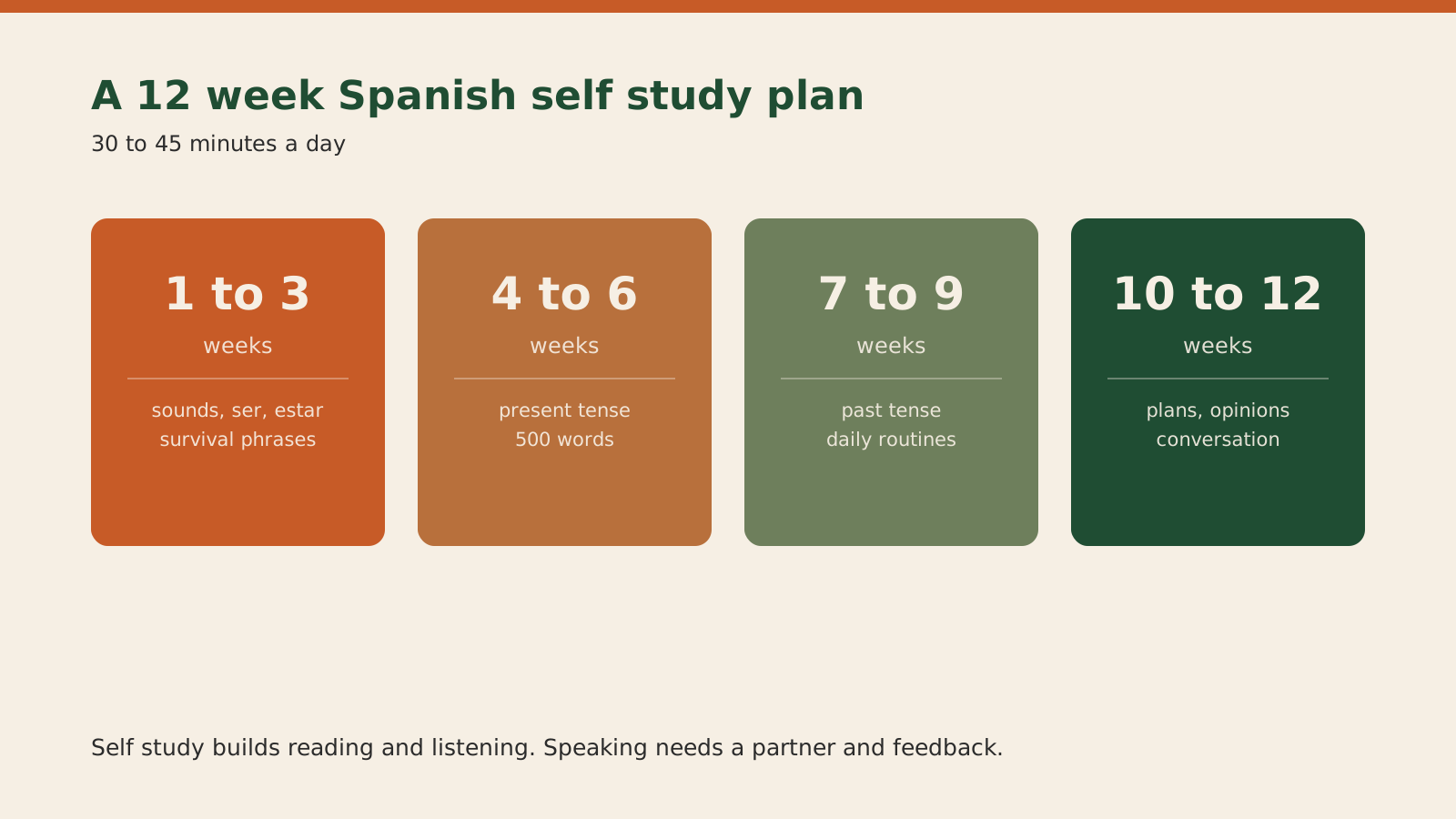
Study Spanish 30 to 45 minutes every day. Spend weeks 1 to 3 on pronunciation, ser and estar, and survival phrases; weeks 4 to 6 on the present tense and 500 common words; weeks 7 to 9 on the past tense; and weeks 10 to 12 on conversation. Listen daily, speak aloud daily, and get feedback weekly.
Key Takeaways
- Short daily sessions of 30 to 45 minutes work better than long weekend sessions, because memory fades between study days.
- Cambridge English estimates 90 to 100 guided learning hours to reach the first CEFR level, A1, and 180 to 200 to reach A2.
- Self study builds reading, listening and vocabulary well, but it rarely builds confident speaking on its own.
- Spaced repetition flashcards help vocabulary stick for the long term.
- The Instituto Cervantes 2025 yearbook counts more than 24 million people studying Spanish as a foreign language.
Can you really learn Spanish on your own?
Yes, you can reach a solid beginner or low intermediate level of Spanish on your own, especially in reading and listening. Most self learners hit a wall with speaking, because speaking needs another person and feedback.
The US Foreign Service Institute estimates about 30 weeks, or roughly 750 class hours, of full time study for an English speaker to reach professional proficiency in Spanish. A self learner studying 45 minutes a day will take longer than that, but the first levels come within months.
| Skill | How well self study builds it | Why |
|---|---|---|
| Reading | Strong | Graded readers and articles exist at every level |
| Listening | Strong | Podcasts, video and music give unlimited input |
| Vocabulary | Strong | Flashcard apps handle review well |
| Grammar | Good | Books explain rules, but you cannot check your own use |
| Writing | Fair | You can write daily, but errors go uncorrected |
| Speaking | Weak | It needs a partner and real time correction |
What should you learn first when teaching yourself Spanish?
Start with pronunciation, then the two verbs for “to be”, then survival phrases. This order lets you read aloud correctly and say real sentences in the first week.
Spanish spelling is close to phonetic, with five vowel sounds that never change, so pronunciation is a quick first win. Next come ser and estar, the two verbs for “to be”, which appear in almost every sentence. Our Spanish for beginners guide covers the first steps in more detail.
How to learn Spanish on your own: what does a 12 week plan look like?
The plan below assumes 30 to 45 minutes a day, six days a week, with one rest or review day. It covers roughly 60 to 80 hours, which is most of the way to the first CEFR level.
| Weeks | Focus | Goals by the end |
|---|---|---|
| 1 to 3 | Pronunciation, ser and estar, greetings, numbers, 150 common words | Read aloud correctly, introduce yourself, say where you are from |
| 4 to 6 | Present tense of regular and common irregular verbs, questions, 500 words | Describe your day, ask and answer simple questions |
| 7 to 9 | Preterite past tense, time expressions, daily routines, 800 words | Talk about last weekend and simple past events |
| 10 to 12 | Near future with ir a, opinions with me gusta and creo que, conversation | Make plans and hold a short conversation on familiar topics |
Each week should include all four skills, even when one topic is the focus. A week spent only on grammar tables tends to be forgotten by the next.
What should a weekly self study routine include?
A good weekly routine rotates skills so you touch each one several times. Set fixed times, because a routine you do not have to decide on each day is the one you keep.
| Day | Main task, 20 to 30 minutes | Daily habit, 10 to 15 minutes |
|---|---|---|
| Monday | New grammar point with examples | Flashcard review |
| Tuesday | Practice exercises on Monday’s grammar | Listen to a short podcast episode |
| Wednesday | Read a short text and note new words | Flashcard review |
| Thursday | Write five to ten sentences about your day | Shadow a short audio clip aloud |
| Friday | Speaking practice with a partner or recording | Flashcard review |
| Saturday | Watch a video or show in Spanish with Spanish subtitles | Review the week’s new words |
| Sunday | Rest or light review | Optional music or video |
Our article on how to create a self study language schedule that works explains how to fit a routine like this around school and other commitments.
Which tools help you learn Spanish at home?
Use one main tool per skill instead of collecting many apps. Switching tools often feels productive but spreads your time thin.
| Skill | Tool type | How to use it |
|---|---|---|
| Vocabulary | Spaced repetition flashcards | Review daily, add 10 new words a day |
| Grammar | One structured textbook or course | Follow it in order, one chapter a week |
| Listening | Podcasts for learners, then native podcasts | Listen daily, then relisten to the same episode |
| Video | YouTube channels for learners | Watch with Spanish subtitles, then without |
| Reading | Graded readers, then news for learners | Read short texts and look up only key words |
| Speaking | Recording yourself, language exchanges, a tutor | Speak aloud every day, even alone |
Our list of YouTube channels for language learners is a good place to start for free listening practice.
A language exchange can cover part of the speaking gap. Two learners meet for an hour, spend half of it in Spanish and half in English, and correct each other. For students under 18, use exchanges run by a school, a library or a platform a parent has approved. An exchange partner is a fellow learner, so expect friendly practice more than precise correction.
Where does self study fall short?
Self study falls short in speaking and feedback. You can learn rules, words and sounds alone, but you cannot reliably hear your own mistakes or practice answering a real person in real time.
Three problems show up in most self learners by week 6 to 8:
- Errors become habits. Without correction, mistakes such as estoy hambre instead of tengo hambre repeat until they feel normal.
- Speaking freezes. Learners who understand a lot often struggle to answer quickly, because they have practiced input far more than output.
- Motivation dips. Once early wins fade, many self learners lose their routine.
A weekly session with a live teacher solves all three. It gives correction, real speaking time and a fixed appointment that keeps the routine going. LanguageBird offers that in the Spanish program, through live one to one classes with native level instructors.
The main reason we study a foreign language is to be able to communicate, so meaningful communication is the main focus of my lessons.
Millie G, ESOL & Spanish Instructor at LanguageBird
How long does it take to learn Spanish on your own?
At 30 to 45 minutes a day, most self learners reach A1 in about three to four months and A2 in about seven to nine months. Cambridge English estimates 90 to 100 guided learning hours for A1 and 180 to 200 for A2, counting lessons and supervised study.
Self study usually takes longer than those figures, because practice without feedback is less efficient. If speed is your main goal, our guide on how to learn Spanish fast covers the methods that compress the timeline.
What do people get wrong about teaching themselves Spanish?
A few beliefs lead self learners to waste time or quit early.
| Common belief | What is actually true |
|---|---|
| One app is enough to become fluent | Apps help with vocabulary, but speaking and feedback need people |
| You should wait to speak until you are ready | Speaking from week one builds confidence and memory faster |
| More hours on weekends make up for missed days | Daily short sessions beat occasional long ones |
| Grammar has to be perfect before conversation | Simple, imperfect sentences are how conversation skills grow |
| Watching shows with English subtitles teaches Spanish | Spanish subtitles, or none, build far more listening skill |
Frequently Asked Questions About Learning Spanish on Your Own
Can I learn Spanish by myself?
Yes, you can reach a solid beginner or low intermediate level by yourself with daily study, especially in reading, listening and vocabulary. Speaking is the hardest skill to build alone, because it needs another person and real time feedback. Most self learners add a tutor, class or language exchange once they reach a basic level.
How many hours a day should I study Spanish on my own?
Thirty to forty five minutes a day is enough for steady progress, as long as you study almost every day. Short daily sessions work better than long weekend sessions, because review is spread out. Split the time between new material and review, and include a few minutes of speaking aloud every day.
What is the best way to teach yourself Spanish?
Follow a structured plan instead of jumping between resources. Start with pronunciation, ser and estar, and survival phrases, then move to the present tense and high frequency words. Use one textbook for grammar, flashcards for vocabulary, podcasts for listening, and speak aloud daily. Add live speaking practice as soon as you can.
How long does it take to learn Spanish at home?
At 30 to 45 minutes a day, most learners reach the first CEFR level, A1, in about three to four months, and A2 in about seven to nine months. Cambridge English estimates 90 to 100 guided learning hours for A1. Conversational fluency usually takes one to two years of consistent study and speaking practice.
What are the biggest mistakes self taught Spanish learners make?
The most common mistakes are waiting too long to speak, relying on a single app, studying only grammar, and letting errors become habits without correction. Many learners also study in long irregular bursts instead of short daily sessions. A fixed routine and regular feedback from a teacher or partner prevent most of these problems.
Do I need a teacher to learn Spanish?
You do not need a teacher to start, but a teacher speeds up speaking and pronunciation. Self study handles reading, vocabulary and listening well. A teacher adds real time correction and conversation practice, which self learners struggle to get on their own. Many learners combine both: self study most days and one live lesson a week.
Does self study Spanish count for high school credit?
No. Schools give credit for courses from an accredited school, so apps and self study do not count on their own, although some schools let a student test into a higher level. LanguageBird offers accredited middle and high school credit through live one to one classes with native level instructors, which fit alongside a self study plan. The high school course catalog lists the Spanish courses.
Add a Live Teacher to Your Self Study Plan
Self study gets you far in reading, listening and vocabulary. The step from understanding Spanish to speaking it with confidence is where a live teacher makes the biggest difference, because every lesson is real practice with feedback.
LanguageBird offers live one to one classes with native level instructors in more than a dozen languages. Students can earn accredited middle and high school credit, and our A to G approved courses count toward University of California admission requirements. Explore the Spanish program or browse the high school course catalog.
Sources
- US Department of State, Foreign Service Institute: Foreign Language Training
- Instituto Cervantes, El español en el mundo 2025 (yearbook)
- Cambridge English, Guided learning hours