
 Sign In


Every statistic in this article was checked against its original source on October 21, 2026.
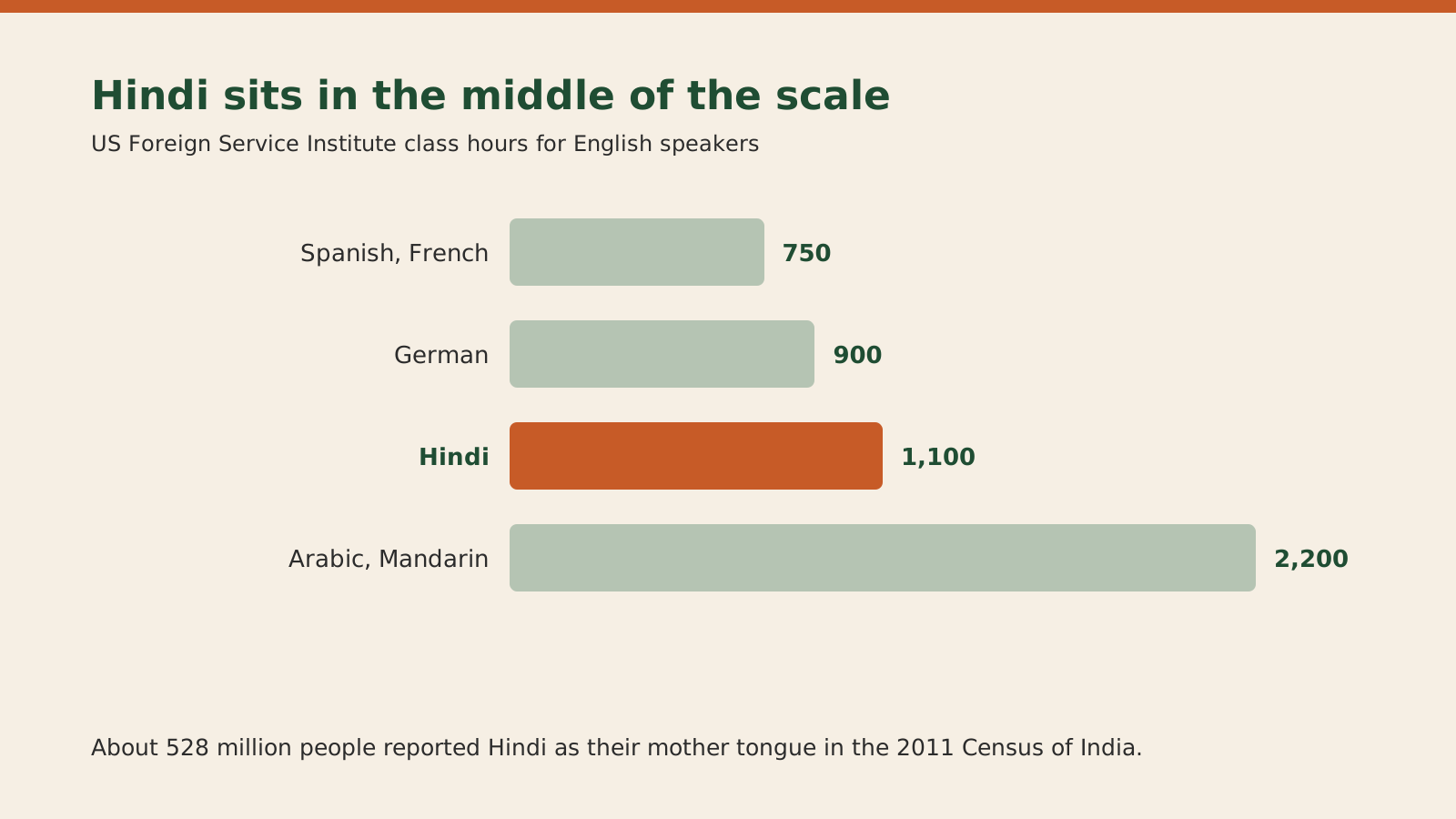
Hindi takes an English speaker a moderate amount of time, more than Spanish and about half as long as Mandarin. The US Foreign Service Institute estimates 44 weeks, or about 1,100 class hours, of full time study for professional proficiency.
So is Hindi hard to learn? The script looks intimidating and turns out to be one of the fastest parts, because Devanagari is written almost exactly as it sounds. The harder parts are new consonant sounds, verb endings that change for gender and a sentence order that puts the verb last. The LanguageBird Hindi program page shows how lessons handle each one.
Quick Answer
Hindi is a Category III language for English speakers, which the US Foreign Service Institute estimates at 44 weeks, or about 1,100 class hours, to professional proficiency. Its Devanagari script is phonetic, so most learners read simple words within a few weeks. The real work is in new sounds, gendered verbs and subject, object, verb order.
Key Takeaways
- The Foreign Service Institute estimates about 1,100 class hours for Hindi, compared with about 750 for Spanish.
- Devanagari is phonetic, so once you learn the letters you can read most words aloud correctly.
- Hindi puts the verb at the end of the sentence: “I Hindi learn” instead of “I learn Hindi”.
- Verbs change for the gender of the subject, so a man and a woman say “I learn” differently.
- The 2011 Census of India counted about 528 million people with Hindi as their mother tongue.
Is Hindi hard to learn compared to other languages?
Hindi sits in the middle of the difficulty scale for English speakers. It takes longer than European languages that share Latin roots with English, and less time than Arabic, Mandarin, Japanese or Korean.
| FSI category | Weeks of study | Class hours | Example languages |
|---|---|---|---|
| I | 24 to 30 | 600 to 750 | Spanish, French, Italian |
| II | 36 | 900 | German |
| III | 44 | 1,100 | Hindi, Hebrew, Russian, Greek |
| IV | 88 | 2,200 | Arabic, Mandarin, Japanese, Korean |
Hindi is a distant relative of English. Both belong to the Indo European family, which is why a few basic words line up: nām and name, dā̃t (tooth) and dental. The family link is old, though, so most vocabulary still has to be learned from scratch.
How hard is the Hindi alphabet?
The Hindi alphabet, the Devanagari script, takes most learners two to four weeks to read slowly. It is far more consistent than English spelling, which makes it one of the faster parts of the language.
Devanagari works differently from the Latin alphabet in three ways:
- Each consonant carries a built in a sound, so क is read ka.
- Other vowels attach to the consonant as small marks above, below or beside it: कि is ki, कु is ku, के is ke.
- Letters in a word hang from a horizontal line across the top, called the shirorekha.
Hindi is usually taught with 11 vowels and 33 consonants, plus combined consonant forms that appear in some words. The one regular exception to “read it as it is written” is that the built in a sound is often silent at the end of a word, so कमल is read kamal. Our introduction to the Devanagari script walks through the letters one group at a time.
Which Hindi sounds are hardest for English speakers?
The hardest sounds are pairs that English treats as the same sound. Hindi separates them, and switching one for another can change the word.
| Distinction | Example pair | What English speakers miss |
|---|---|---|
| Aspirated vs unaspirated | क ka and ख kha | Hindi uses a puff of air to tell words apart, while English adds or drops it automatically by position |
| Dental vs retroflex | त ta and ट ṭa | One t touches the teeth, the other curls the tongue back |
| Dental vs retroflex d | द da and ड ḍa | The same tongue position contrast as t |
| Nasal vowels | है hai and हैं hain | A nasal vowel can turn singular into plural |
Most learners hear these differences only after a teacher points them out several times. The good habit to build early is to listen for them in short, slow recordings and repeat them aloud.

What makes Hindi grammar different from English?
Hindi grammar differs from English in word order, gender and how small words like “in” and “on” work. None of these rules is hard on paper. They take practice because they run against English instinct.
| Feature | English | Hindi | Example |
|---|---|---|---|
| Word order | Subject, verb, object | Subject, object, verb | मैं हिंदी सीखता हूँ (main hindi seekhta hoon, I Hindi learn) |
| Prepositions | Before the noun: in the house | After the noun: house in | घर में (ghar mein) |
| Gender | Mostly on pronouns | On nouns, adjectives and verbs | seekhta (male speaker), seekhti (female speaker) |
| Formality | One “you” | Three levels of “you” | tu, tum, aap |
| Articles | a, an, the | None | किताब (kitab) means a book or the book |
The rule that takes longest is the past tense marker ne. With many verbs in the completed past, the subject takes ne and the verb agrees with the object instead of the subject. Most learners meet it in their second year and need a few months of practice before it feels natural.
What is the difference between Hindi and Urdu?
Spoken Hindi and spoken Urdu are close enough that speakers of each usually understand everyday conversation in the other. They differ mainly in script and in formal vocabulary. Hindi is written in Devanagari and draws formal words from Sanskrit, while Urdu is written in a Perso Arabic script and draws formal words from Persian and Arabic. A learner of either can follow much casual conversation, film dialogue and music in the other, while news, literature and official language diverge more.
Which parts of Hindi go faster than people expect?
Several features of Hindi give learners early wins, which matters for motivation in the first year.
- Reading arrives early. A phonetic script means you can sound out signs, captions and lyrics within weeks.
- Hindi has no articles, so there is no a, an or the to choose between.
- Everyday Hindi uses many English loanwords, such as school, bus, phone and computer.
- English already uses words from Hindi, including shampoo, jungle, pajamas, bungalow and loot.
- Film and music give learners endless listening material with built in motivation.
I focus on building real-world communication skills through authentic materials, natural conversation, and culture-based activities rather than traditional textbooks.
Aditya Y, Hindi Instructor at LanguageBird
What do people get wrong about learning Hindi?
Most worries about Hindi come from the look of the script and the size of the country, and neither predicts how hard the language is.
| Common belief | What is actually true |
|---|---|
| The script takes years | Most learners read simple words within two to four weeks |
| Hindi is as hard as Mandarin | The FSI puts Hindi at 1,100 hours and Mandarin at 2,200 |
| You need perfect pronunciation to be understood | Context carries a lot, though aspirated and retroflex sounds are worth fixing early |
| Hindi and Urdu are completely different languages | Everyday speech is largely shared. Script and formal vocabulary differ |
| You can learn Hindi from Bollywood alone | Films help listening, but they skip grammar and use informal speech |
How long does it take to learn Hindi?
With regular lessons, most learners read Devanagari within a month, hold simple conversations within six months to a year, and reach comfortable conversation in about two years. The FSI figure of 1,100 class hours describes intensive, full time study toward professional use.
| Stage | Typical time with regular lessons | What you can do |
|---|---|---|
| Script | 2 to 4 weeks | Read and write Devanagari slowly, sound out new words |
| Survival Hindi | 2 to 4 months | Greet people, introduce yourself, shop and ask directions |
| Conversational | 1 to 2 years | Talk about family, school and plans, follow slow speech |
| Professional | 3 or more years | Follow news and films, handle work conversations |
A good first step is a small set of words you can use right away. Our list of simple Hindi words for beginners covers greetings and everyday basics, and our Diwali vocabulary guide adds cultural words students hear every autumn.
In the Hindi program, LanguageBird teaches through live one to one classes with native level instructors, which helps most with the sound pairs and the ne construction, the two areas where self study usually stalls.
Frequently Asked Questions About Learning Hindi
Is Hindi harder than Spanish for English speakers?
Yes. The US Foreign Service Institute estimates about 1,100 class hours for Hindi and about 750 hours for Spanish. Spanish shares an alphabet and thousands of Latin based words with English. Hindi needs a new script, new consonant sounds, verbs that agree with gender and a sentence order that places the verb at the end.
How long does it take to learn the Hindi alphabet?
Most learners read Devanagari slowly within two to four weeks of daily practice. The script is phonetic, so each letter has a consistent sound, and vowels attach to consonants as small marks. Reading quickly takes longer, mostly because of combined consonant forms, but sounding out words comes early in the first month.
Is Hindi grammar hard?
Hindi grammar is regular but unfamiliar. The verb goes at the end, small words like “in” come after the noun, and verbs change for the subject’s gender. The hardest rule for most students is the past tense marker ne, which makes the verb agree with the object. It usually takes a few months of practice.
Can I learn Hindi and Urdu at the same time?
Spoken Hindi and Urdu share most everyday vocabulary and grammar, so learning to speak one gives you much of the other. The scripts are completely different, though, and formal vocabulary splits between Sanskrit and Persian or Arabic sources. Most learners focus on one written language first and pick up the other’s speech along the way.
How many people speak Hindi?
The 2011 Census of India counted about 528 million people, or 43.6 percent of the population, who reported Hindi as their mother tongue. Another 139 million reported it as a second language, so Hindi is a first or second language for about 55 percent of India. Large communities also live in Nepal, Fiji, the Gulf states and the United States.
Is Hindi useful to learn?
Hindi connects learners to India, one of the largest economies and the most populous country in the world, as well as to a global diaspora and a large film and music industry. Few US students study it, so Hindi skills stand out in business, technology, medicine, research and international relations, and with family members who speak it.
Can you earn high school credit for Hindi online?
Yes. When a high school does not offer Hindi, students can take it through an accredited online school and add the credit to their transcript once a counselor approves the transfer. LanguageBird offers accredited middle and high school credit in Hindi through live one to one classes with native level instructors, and the high school course catalog lists the Hindi courses.
Learn Hindi With a Live Instructor
The script will take you a few weeks. The sounds, the gender endings and the ne construction take longer, and they move fastest when someone hears you speak and corrects you in the moment.
LanguageBird offers live one to one classes with native level instructors in more than a dozen languages. Students can earn accredited middle and high school credit, and our A to G approved courses count toward University of California admission requirements. Explore the Hindi program or browse the high school course catalog.
Sources
- US Department of State, Foreign Service Institute: Foreign Language Training
- Census of India 2011, language data