
 Sign In


Every statistic in this article was checked against its original source on October 21, 2026.
Spanish language levels are measured on two main scales: the European CEFR, which runs from A1 to C2, and the American ACTFL scale, which runs from Novice to Distinguished. Both describe what a learner can actually do in Spanish, from ordering food to arguing a point in a meeting.
Knowing the Spanish language levels helps you set a realistic goal, choose the right exam and understand what a placement result means. This guide explains each level, lines the two scales up, and shows how long each step usually takes. To see how live one to one classes fit into that path, visit the LanguageBird Spanish program.
Quick Answer
The CEFR has six Spanish levels: A1 and A2 for basic users, B1 and B2 for independent users, and C1 and C2 for proficient users. ACTFL, the scale most US schools use, has five main levels: Novice, Intermediate, Advanced, Superior and Distinguished, with the first three split into Low, Mid and High.
Key Takeaways
- The Common European Framework of Reference, published by the Council of Europe in 2001, defines six levels from A1 to C2.
- ACTFL uses Novice, Intermediate, Advanced, Superior and Distinguished, and most US high school students test in the Novice to Intermediate range.
- Cambridge English estimates about 500 to 600 guided learning hours to reach B2 from zero.
- The Instituto Cervantes DELE exams certify every CEFR level from A1 to C2, and the certificates do not expire.
- The Global Seal of Biliteracy starts at ACTFL Intermediate Mid, which roughly matches CEFR B1.
What are the Spanish language levels from A1 to C2?
The CEFR splits Spanish into six levels grouped in three bands. Each level is defined by “can do” statements, which describe real tasks a learner can handle.
| Level | Band | What it means in practice |
|---|---|---|
| A1 | Basic user | Introduce yourself, ask simple questions, understand slow, clear speech |
| A2 | Basic user | Handle routine exchanges about shopping, family, school and directions |
| B1 | Independent user | Get by while traveling, describe experiences, give reasons for opinions |
| B2 | Independent user | Talk with native speakers without strain, follow most films and news |
| C1 | Proficient user | Use Spanish flexibly for school and work, understand implied meaning |
| C2 | Proficient user | Understand almost everything, express fine shades of meaning |
The jump from A2 to B1 is the one most learners feel. At A2 you can survive. At B1 you can start keeping a conversation going on your own.
What are the ACTFL proficiency levels?
ACTFL, the American Council on the Teaching of Foreign Languages, publishes the proficiency scale used by most US schools, colleges and state seals of biliteracy. Its guidelines, last revised in 2024, describe five main levels.
| ACTFL level | Sublevels | What a speaker can do |
|---|---|---|
| Novice | Low, Mid, High | Communicate with memorized words and phrases |
| Intermediate | Low, Mid, High | Create original sentences, ask and answer questions on familiar topics |
| Advanced | Low, Mid, High | Narrate and describe in all major time frames, in paragraphs |
| Superior | None | Support opinions, hypothesize, discuss abstract topics |
| Distinguished | None | Tailor language precisely to any audience and purpose |
A useful way to remember the ACTFL scale is by the size of the language a speaker produces: words at Novice, sentences at Intermediate, paragraphs at Advanced, and extended argument at Superior.
How do CEFR and ACTFL levels compare?
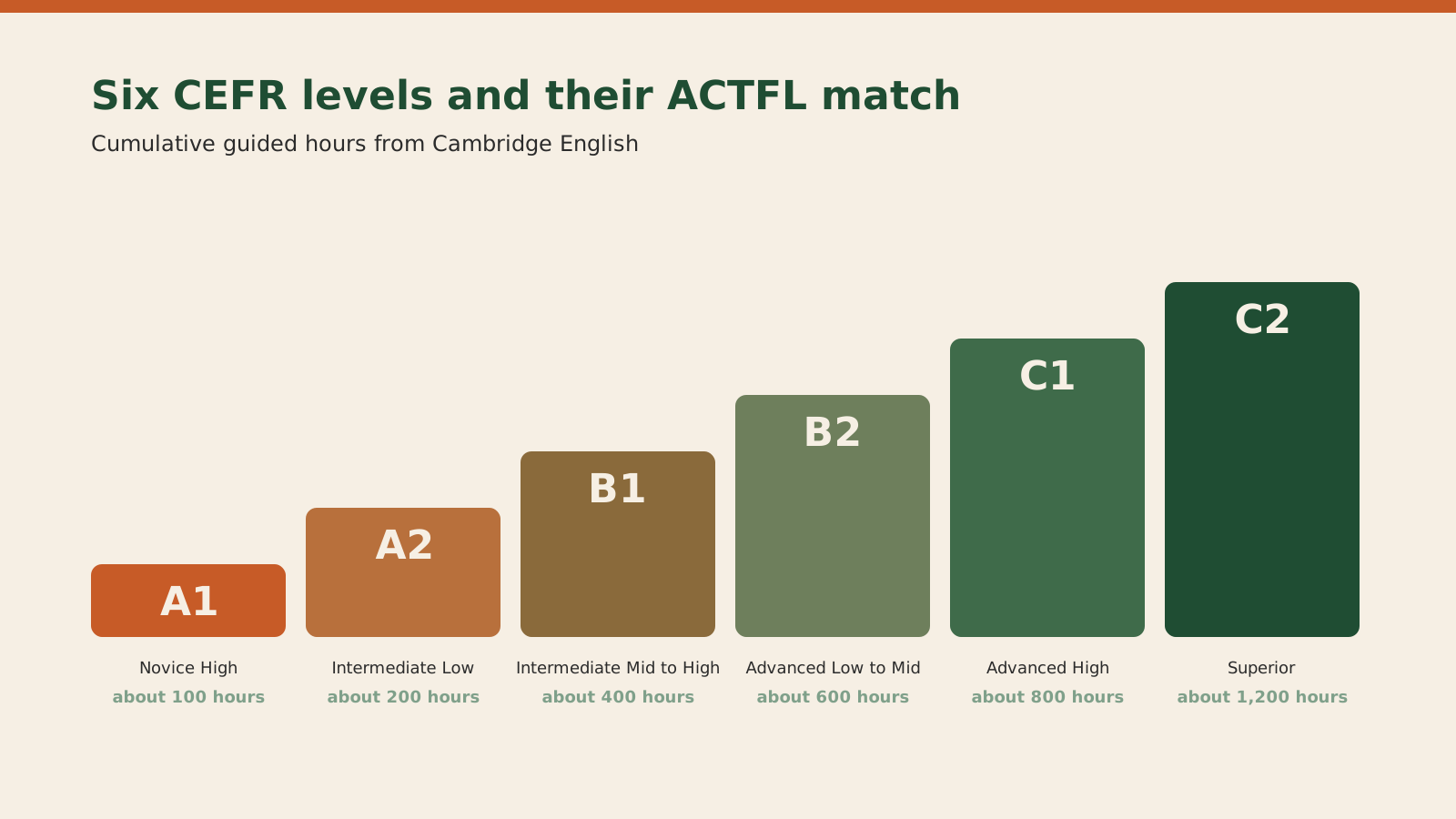
CEFR and ACTFL levels line up roughly, though not perfectly, because they were built for different purposes. ACTFL publishes official correspondences between its ratings and CEFR levels, and the table below follows its alignment for speaking and writing.
| ACTFL rating | CEFR equivalent |
|---|---|
| Novice Low and Novice Mid | Below A1 |
| Novice High | A1 |
| Intermediate Low | A2 |
| Intermediate Mid | B1 (lower) |
| Intermediate High | B1 (upper) |
| Advanced Low | B2 (lower) |
| Advanced Mid | B2 (upper) |
| Advanced High | C1 |
| Superior | C2 |
These are ACTFL’s own correspondences for speaking and writing. For reading and listening, ACTFL places each level lower, with Intermediate Mid at A2. Use the table as a translation guide between systems. A student rated Intermediate Mid on a US exam and a student certified B1 in Spain can handle similar conversations, even though the tests measured them differently.
How long does it take to reach each Spanish level?
Most learners reach A2 in about 180 to 200 guided hours, B1 in 350 to 400, and B2 in 500 to 600. Those figures come from Cambridge English, which publishes guided learning hours for each CEFR level and counts both lessons and supervised study.
| CEFR level | Cumulative guided hours | With 3 hours a week |
|---|---|---|
| A1 | 90 to 100 | About 8 months |
| A2 | 180 to 200 | About 1.5 years |
| B1 | 350 to 400 | About 2.5 years |
| B2 | 500 to 600 | About 3.5 years |
| C1 | 700 to 800 | About 5 years |
| C2 | 1,000 to 1,200 | About 7 years |
Cambridge measured these hours for learners of English, so treat them as a planning guide for Spanish. For English speakers learning Spanish, the US Foreign Service Institute estimates about 30 weeks, or roughly 750 class hours, of full time study for professional working proficiency. That is close to the C1 range on the Cambridge scale.
Weekly hours change the calendar more than talent does. A student with three live lessons a week plus practice moves far faster than one with a single class. In our Spanish program, those lessons are live one to one classes with native level instructors.
What can you do at each Spanish level?
The clearest way to understand a level is by the tasks it makes possible. Here is what each CEFR level looks like in real life for a student of Spanish.
| Level | Typical task | Example |
|---|---|---|
| A1 | Introduce yourself | Me llamo Ana, tengo quince años y vivo en Texas. |
| A2 | Make plans | ¿Quieres ir al cine el sábado por la tarde? |
| B1 | Tell a story in the past | El verano pasado viajé a México y visité a mi familia. |
| B2 | Argue a point | Creo que las escuelas deberían empezar más tarde porque los estudiantes duermen poco. |
| C1 | Adjust tone for an audience | Present the same idea formally to a teacher and casually to a friend |
| C2 | Catch nuance | Follow jokes, irony and regional expressions without explanation |
Many learners can hold a basic conversation at A2 or B1 long before they feel fluent. Our article on fluent vs conversational language skills explains where that line usually falls.
Which exams certify Spanish language levels?
The main exams certify Spanish on the CEFR scale, the ACTFL scale, or both. The right one depends on whether the result is for school, college or work.
| Exam | Scale | Who runs it | Common use |
|---|---|---|---|
| DELE | CEFR, one exam per level from A1 to C2 | Instituto Cervantes | Study and work in Spanish speaking countries |
| SIELE | CEFR, one test covering A1 to C1 | Instituto Cervantes and partner universities | Flexible certification, results within weeks |
| ACTFL OPI and OPIc | ACTFL | ACTFL | US schools, colleges and employers |
| AAPPL and STAMP | ACTFL | Assessment providers used by US schools | Seals of biliteracy and placement |
DELE diplomas do not expire, which makes them useful for students who want a permanent credential. SIELE results are valid for five years.
I’m a certified K-12 teacher and AP Spanish teacher certified by the College Board.
Ana B, Spanish Instructor at LanguageBird
How do Spanish levels connect to the Global Seal of Biliteracy?
The Global Seal of Biliteracy certifies proficiency in two languages at three ACTFL based levels, and high school students can earn it before graduating. It turns a test score into a credential students can list on applications and resumes.
| Global Seal level | ACTFL minimum | Approximate CEFR |
|---|---|---|
| Functional Fluency | Intermediate Mid | B1 |
| Working Fluency | Advanced Low | B2 |
| Professional Fluency | Advanced High | C1 |
Students can take the Global Seal of Biliteracy exam through the LanguageBird Global Seal program. Our article on reasons to earn the Global Seal of Biliteracy covers how colleges and employers use it.

What do people get wrong about Spanish levels?
Level labels sound precise, which leads to a few common misunderstandings.
| Common belief | What is actually true |
|---|---|
| Spanish 3 in high school equals B1 or level 3 | School course numbers measure years of study. Proficiency varies a lot between students |
| B2 means fluent | B2 is comfortable independence. Fluency usually describes C1 and above |
| You need C2 to use Spanish at work | Many jobs work well at B2, especially with support |
| A level applies equally to every skill | Most learners read at a higher level than they speak |
| CEFR and ACTFL levels match exactly | They align roughly. ACTFL publishes official correspondences, and they are approximate |
Frequently Asked Questions About Spanish Language Levels
What are the six Spanish language levels?
The CEFR, the European framework most exams use, defines six Spanish levels: A1, A2, B1, B2, C1 and C2. A1 and A2 are basic users, B1 and B2 are independent users, and C1 and C2 are proficient users. Each level is defined by tasks, such as introducing yourself at A1 or arguing a point at B2.
What Spanish level is considered fluent?
Most teachers and employers treat C1 as fluent. At C1 a learner uses Spanish flexibly for school and work and understands implied meaning. B2 is comfortable independence: you can talk with native speakers without strain. Many people describe B2 as fluent in everyday life, while C1 covers professional and academic use.
How long does it take to reach B1 in Spanish?
Cambridge English estimates about 350 to 400 guided learning hours to reach B1 from zero, counting lessons and supervised study. At three hours a week, that is roughly two and a half years. Students with more weekly practice, or with Spanish at home, often reach B1 much faster.
What is the difference between CEFR and ACTFL?
The CEFR, from the Council of Europe, uses six levels from A1 to C2 and is standard in Europe and in international exams like DELE. ACTFL, from the American Council on the Teaching of Foreign Languages, uses Novice to Distinguished and is standard in US schools. ACTFL publishes official correspondences between the two scales.
What Spanish level do high school students usually reach?
After two to four years of school Spanish, many US students test in the ACTFL Novice High to Intermediate Mid range, roughly CEFR A1 to B1. Results vary widely with weekly speaking time. Students who speak regularly in small classes or one to one lessons often test a level or more higher.
Do DELE certificates expire?
No. DELE diplomas from the Instituto Cervantes do not expire, which makes them a permanent record of your Spanish level. There is a separate DELE exam for each CEFR level, from A1 to C2. SIELE, a shorter adaptive test that covers several levels at once, issues results that stay valid for five years.
Can middle school students earn credit for Spanish?
Yes, through an accredited program. Middle school credit can help a student start high school Spanish at a higher level, although each high school sets its own placement rules, so ask a counselor first. LanguageBird offers accredited middle and high school credit through live one to one classes with native level instructors, and the high school course catalog lists the Spanish courses for the high school years.
Move Up a Spanish Level With a Live Instructor
Every level on these scales is defined by what you can do out loud and on paper, under some pressure. Getting there depends less on how many textbook chapters you finish and more on how often you speak and get corrected.
LanguageBird offers live one to one classes with native level instructors in more than a dozen languages. Students can earn accredited middle and high school credit, and our A to G approved courses count toward University of California admission requirements. Explore the Spanish program, browse the high school course catalog, or see the Global Seal of Biliteracy program.