
 Sign In


Every statistic in this article was checked against its original source on October 21, 2026.
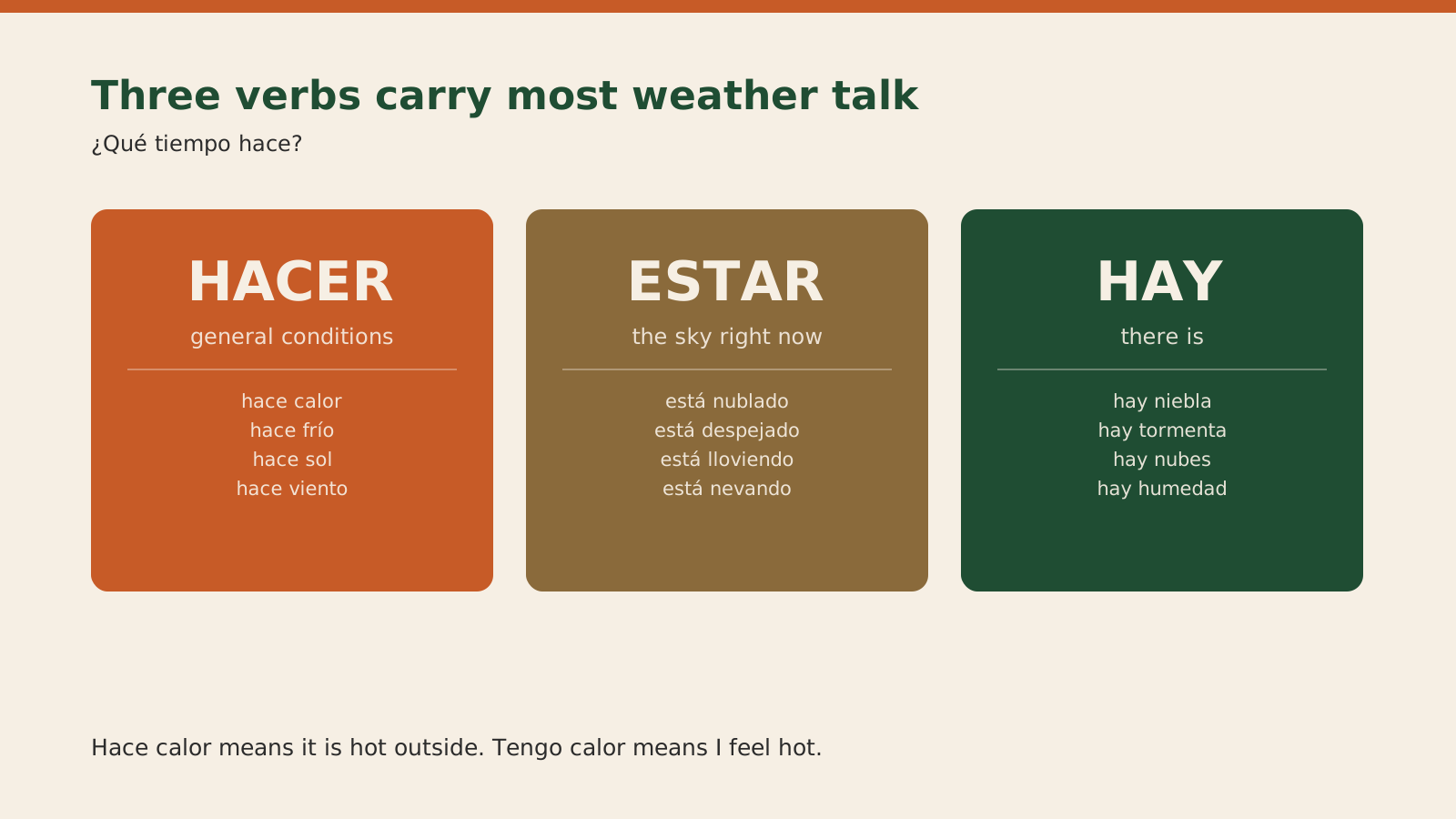
To talk about the weather in Spanish, you ask ¿Qué tiempo hace? and answer with one of three verbs: hacer, estar or hay. Hace calor means it is hot, está nublado means it is cloudy, and hay niebla means there is fog.
Learning Spanish weather terms by verb is faster than learning them as a word list, because the verb tells you how the whole phrase works. This guide groups the vocabulary that way, then adds seasons, temperature and a few regional words. For conversation practice with these phrases, visit the LanguageBird Spanish program.
Quick Answer
Ask about the weather with ¿Qué tiempo hace? The five answers beginners need first are hace sol (it is sunny), hace calor (it is hot), hace frío (it is cold), está nublado (it is cloudy) and está lloviendo (it is raining). Spanish uses hacer, estar or hay to describe weather.
Key Takeaways
- Hacer describes general conditions: hace sol, hace calor, hace frío, hace viento.
- Estar describes the state of the sky right now: está nublado, está despejado, está lloviendo.
- Hay means “there is” and goes with nouns: hay niebla, hay tormenta, hay nubes.
- Llueve and nieva work alone, with no subject, just like “it rains” and “it snows”.
- Tengo calor means “I feel hot”, while hace calor means “the weather is hot”.
How do you ask about the weather in Spanish?
The standard question is ¿Qué tiempo hace?, which means “What is the weather like?” Spanish speakers also ask ¿Cómo está el tiempo? or ¿Cómo está el clima?, especially in Latin America.
| Question | Translation | When to use it |
|---|---|---|
| ¿Qué tiempo hace? | What is the weather like? | Everywhere, the classroom standard |
| ¿Cómo está el tiempo? | How is the weather? | Common in conversation |
| ¿Cómo está el clima hoy? | How is the weather today? | Very common in Latin America |
| ¿Qué tiempo va a hacer mañana? | What will the weather be tomorrow? | Asking about the forecast |
| ¿A cuántos grados estamos? | What is the temperature? | Asking for the number |
Strictly speaking, el tiempo is the weather on a given day and el clima is the long term climate of a place. In everyday speech across Latin America, though, people use el clima for both.
Which Spanish weather terms use hacer?
Hacer, which normally means “to do” or “to make”, describes general weather conditions. You always use the third person form, hace, and no subject.
| Spanish | English |
|---|---|
| Hace sol. | It is sunny. |
| Hace calor. | It is hot. |
| Hace frío. | It is cold. |
| Hace viento. | It is windy. |
| Hace fresco. | It is cool. |
| Hace buen tiempo. | The weather is nice. |
| Hace mal tiempo. | The weather is bad. |
To make these stronger, add mucho: hace mucho calor, it is very hot. Calor and frío take mucho instead of muy, because they are nouns in Spanish. Literally, hace mucho calor means “it makes a lot of heat”.
Which Spanish weather terms use estar?
Estar describes how the sky or the day looks right now, often with an adjective or an ing form. It pairs with weather the same way it pairs with moods and conditions.
| Spanish | English |
|---|---|
| Está nublado. | It is cloudy. |
| Está despejado. | It is clear. |
| Está soleado. | It is sunny out. |
| Está lloviendo. | It is raining. |
| Está nevando. | It is snowing. |
| Está húmedo. | It is humid. |
Está lloviendo describes rain falling at this moment. Llueve, on its own, can describe rain right now or rain in general: en abril llueve mucho, it rains a lot in April. Both use forms you learn with the present tense in Spanish.
Which Spanish weather terms use hay?
Hay means “there is” or “there are”, and it comes before a noun. It is the most flexible weather verb because it works with any weather noun.
| Spanish | English |
|---|---|
| Hay niebla. | It is foggy. |
| Hay tormenta. | There is a storm. |
| Hay nubes. | There are clouds. |
| Hay humedad. | It is humid. |
| Hay relámpagos. | There is lightning. |
| Hay un huracán. | There is a hurricane. |
Four weather verbs stand alone without hacer, estar or hay: llueve (it rains), nieva (it snows), truena (it thunders) and graniza (it hails). Spanish uses them only in the third person singular, because there is no one doing the raining.
What are the most common Spanish weather nouns?
These nouns appear in forecasts, small talk and school readings. Learn each one with its article, since the article tells you the gender.
| Spanish | English | Spanish | English |
|---|---|---|---|
| el sol | sun | la lluvia | rain |
| la nube | cloud | la nieve | snow |
| el viento | wind | la tormenta | storm |
| el trueno | thunder | el relámpago | lightning |
| la niebla | fog | el granizo | hail |
| el huracán | hurricane | el pronóstico | forecast |
How do you say the seasons in Spanish?
The four seasons in Spanish are la primavera (spring), el verano (summer), el otoño (fall) and el invierno (winter). Like months, seasons are not capitalized in Spanish.
Seasons flip in the Southern Hemisphere. In Argentina, Chile and Uruguay, December falls in el verano, so school vacations and summer holidays happen in January and February.
Near the equator, many places talk about wet and dry seasons instead of four seasons. In Costa Rica, people often call the rainy months invierno and the dry months verano, even though the rainy season runs through what the US calls summer. Weather vocabulary changes with geography, which our guide to Spanish speaking countries maps across all 21 countries.
How do you talk about temperature in Spanish?
Most Spanish speaking countries measure temperature in degrees Celsius, so a forecast of 30 degrees means a hot day. To say the temperature, use estamos a plus the number.
- Estamos a 25 grados. It is 25 degrees.
- La temperatura máxima es de 30 grados. The high is 30 degrees.
- Hace cero grados. It is zero degrees.
For quick conversions, 0 degrees Celsius is 32 degrees Fahrenheit, 20 degrees Celsius is 68 degrees Fahrenheit, and 30 degrees Celsius is 86 degrees Fahrenheit.
What weather mistakes do English speakers make in Spanish?
Most weather mistakes come from translating English word for word. The table shows the four that teachers correct most often.
| Common mistake | What to say instead | Why |
|---|---|---|
| Es caliente for “it is hot outside” | Hace calor | Hacer describes the weather |
| Estoy caliente for “I am hot” | Tengo calor | Tener describes how a person feels, and estoy caliente can mean something embarrassing |
| Hace muy calor | Hace mucho calor | Calor is a noun, so it takes mucho |
| Es lloviendo | Está lloviendo | Ongoing actions use estar |
The calor trio is worth memorizing as a set: hace calor for the weather, tengo calor for a person, and está caliente for an object such as soup. A teacher who hears these slips can correct them on the spot, and our Spanish program offers that through live one to one classes with native level instructors.
What regional weather words should you know?
A few weather words change from country to country, which makes sense for a language the Instituto Cervantes 2025 yearbook says about 635 million people can use. Here are some you will hear, with the places they are used.
| Word | Meaning | Where you hear it |
|---|---|---|
| garúa | light drizzle | Peru, Argentina, Uruguay |
| chubasco | short heavy shower | Widely used across Spain and Latin America |
| chispear | to drizzle lightly | Widely used across Spain and Latin America |
| hace un frío que pela | it is bitterly cold | Spain |
| invierno (for the rainy season) | the wet months | Costa Rica and much of Central America |
Currently, I am living in the Canary Islands, Spain, where I have learned the unique characteristics of Spanish on the other side of the ocean.
Mercedes R, Spanish Instructor at LanguageBird
Frequently Asked Questions About Spanish Weather Terms
How do you ask what the weather is like in Spanish?
The standard question is ¿Qué tiempo hace?, which means “What is the weather like?” In Latin America you will also hear ¿Cómo está el clima? To ask about tomorrow, say ¿Qué tiempo va a hacer mañana? Answers usually start with hace, está or hay, followed by the weather condition.
Why does Spanish use hacer for weather?
Spanish treats general weather as something that is made or done, so it uses hacer in the third person: hace calor, hace frío, hace sol. Literally, hace calor means “it makes heat”. English uses “it is” instead. Because calor and frío are nouns in these phrases, intensify them with mucho, as in hace mucho frío.
What is the difference between hace calor and tengo calor?
Hace calor describes the weather: it is hot outside. Tengo calor describes how a person feels: I am hot. For objects, use estar caliente, as in la sopa está caliente, the soup is hot. Saying estoy caliente for “I am hot” can mean something embarrassing to native speakers, so tengo calor is the safe choice.
How do you say it is raining in Spanish?
Say está lloviendo for rain falling right now, or llueve for rain in general or right now. Both are correct. The verb llover only appears in the third person singular, because there is no subject doing the raining. For heavy rain, say está lloviendo mucho, and for drizzle, people often say está chispeando.
What are the four seasons in Spanish?
The seasons are la primavera (spring), el verano (summer), el otoño (fall) and el invierno (winter). They are not capitalized. Remember that seasons are reversed south of the equator, so December is summer in Argentina and Chile, and near the equator people often speak of rainy and dry seasons.
Do Spanish speaking countries use Celsius or Fahrenheit?
Most Spanish speaking countries use Celsius. To say the temperature, use estamos a plus the number, as in estamos a 20 grados. For a quick conversion, 20 degrees Celsius is 68 degrees Fahrenheit and 30 degrees Celsius is 86 degrees Fahrenheit, which helps when you read a forecast abroad.
Does online Spanish count toward the UC A to G requirements?
It can, when the course appears on the University of California list of approved A to G courses. UC requires two years of the same language other than English and recommends three. LanguageBird offers A to G approved courses and accredited middle and high school credit through live one to one classes with native level instructors. Check the high school course catalog for the Spanish courses.
Practice Spanish Weather Talk With a Live Instructor
Weather is the most common small talk in any language, which makes it one of the first topics students use with real people. It is also where hace, está and tengo get mixed up, and those slips fade fastest with someone correcting them in conversation.
LanguageBird offers live one to one classes with native level instructors in more than a dozen languages. Students can earn accredited middle and high school credit, and our A to G approved courses count toward University of California admission requirements. Explore the Spanish program or browse the high school course catalog.
Sources
- Instituto Cervantes, El español en el mundo 2025 (yearbook)
- University of California Admissions, Subject requirement A to G