
 Sign In


Every statistic in this article was checked against its original source on October 21, 2026.
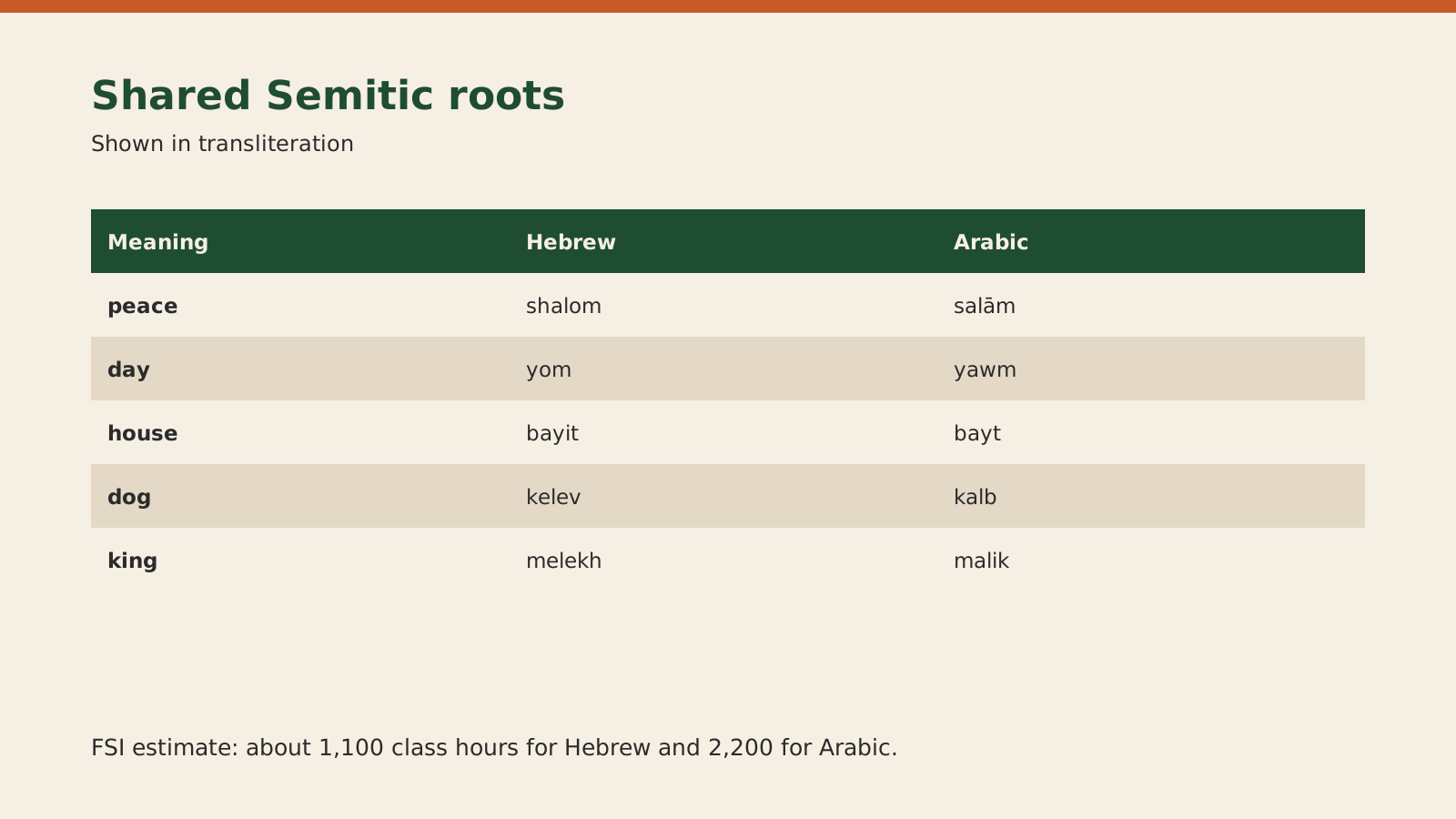
Arabic and Hebrew are closely related Semitic languages: both are written right to left, both build words from three letter roots, and they share many basic words. Shalom and salām both mean peace, and bayit and bayt both mean house.
The Arabic vs Hebrew comparison is also a story of differences: two separate alphabets, different sound systems, and very different learning times for English speakers. This guide compares them strictly as languages. For live one to one classes, see the LanguageBird Arabic program and the Hebrew program.
Quick Answer
Arabic and Hebrew are both Semitic languages written right to left, and both build most words from three letter roots, such as k t b for writing. The US Foreign Service Institute estimates about 1,100 class hours for Hebrew and 2,200 for Arabic. Their alphabets differ: Hebrew has 22 letters, Arabic has 28.
Key Takeaways
- Arabic and Hebrew both belong to the Semitic branch of the Afroasiatic language family.
- Hebrew uses a 22 letter alphabet with separate letters, while Arabic uses 28 letters that connect in cursive.
- Both languages usually leave out short vowels in everyday writing.
- The Foreign Service Institute rates Hebrew at 44 weeks of study and Arabic at 88 weeks for English speakers.
- Many basic words share roots, such as yom and yawm for day, or kelev and kalb for dog.
What is the difference between Arabic and Hebrew?
Arabic and Hebrew differ most in script, sound system and the gap between formal and spoken language. They share grammar structure and a large set of related roots.
| Feature | Arabic | Hebrew |
|---|---|---|
| Language family | Semitic | Semitic |
| Direction | Right to left | Right to left |
| Alphabet | 28 letters, connected cursive | 22 letters, mostly separate, 5 with final forms |
| Short vowels in writing | Usually omitted | Usually omitted |
| Throat and emphatic sounds | Many, still distinct | Fewer in modern everyday speech |
| Formal vs spoken | Modern Standard Arabic plus regional dialects | One modern standard used in speech and writing |
| Dual number | Used for nouns, verbs and adjectives | Limited to some nouns, such as eyes and two days |
| FSI estimate | 88 weeks, about 2,200 hours | 44 weeks, about 1,100 hours |
How are the Arabic and Hebrew alphabets different?
The two alphabets come from a common ancestor but look nothing alike today. Neither reader can read the other script without learning it.
Hebrew has 22 letters. In print, letters stand apart from each other, and five letters take a different shape at the end of a word. Arabic has 28 letters that join in cursive, and most letters change shape depending on whether they come at the start, middle or end of a word.
Both scripts are abjads, which means everyday writing shows consonants and long vowels and leaves out most short vowels. Children’s books, poetry and religious texts add vowel marks. Our comparison of the Latin and Arabic alphabets explains how Arabic letters connect.
What roots do Arabic and Hebrew share?
Many of the most basic words in Arabic and Hebrew come from the same Semitic roots. Once you know the pattern, these pairs stand out in context, even though spelling and sound differ.
| Root | Meaning | Hebrew | Arabic |
|---|---|---|---|
| sh l m / s l m | peace | shalom | salām |
| y w m | day | yom | yawm |
| b y t | house | bayit | bayt |
| k l b | dog | kelev | kalb |
| m l k | king | melekh | malik |
| k t b | write | katav (he wrote) | kataba (he wrote) |
Both languages build families of words from a root. In Hebrew, k t b gives katav (he wrote) and mikhtav (letter). In Arabic, it gives kataba (he wrote), kitāb (book) and maktab (office). A learner of one language starts to recognize these patterns in the other quickly.
How do Arabic and Hebrew sound different?
Arabic keeps more of the older Semitic sound system, while modern spoken Hebrew has simplified it. That is one reason Arabic takes English speakers longer.
Arabic has several sounds made deep in the throat, such as ʿayn and ḥa, and a set of heavy emphatic consonants. These sounds separate words, so learners must master them. In everyday modern Hebrew, many speakers pronounce the throat letters ayin and het as a glottal stop and a kh sound, which take English speakers less effort than the Arabic originals.
Vocabulary also shows regular sound shifts. A Hebrew sh often matches an Arabic s or th: shalom and salām, shalosh and thalātha for three. Learners who know one language begin to predict the other’s words from these patterns.
Does Hebrew take less time to learn than Arabic?
For English speakers, Hebrew usually takes less time. The US Foreign Service Institute places Hebrew in Category III at 44 weeks, or about 1,100 class hours, and Arabic in Category IV at 88 weeks, or about 2,200 class hours.
Three things explain the gap. Arabic has more difficult sounds. Arabic has case endings in its formal grammar, which Hebrew does not. And Arabic learners must handle two registers, Modern Standard Arabic and a spoken dialect, while Modern Hebrew uses one standard for both speech and writing. Our guides on whether Hebrew is hard to learn and whether Arabic is hard to learn cover each language in more depth.
| Stage | Hebrew, with regular lessons | Arabic, with regular lessons |
|---|---|---|
| Read the alphabet | 1 to 3 weeks | 2 to 4 weeks |
| Survival conversation | 2 to 4 months | 3 to 6 months |
| Comfortable conversation | 1 to 2 years | 2 or more years |
Which language is older, Arabic or Hebrew?
Neither language can be dated as “older” in a simple way, because both developed from a shared ancestor, Proto Semitic, over thousands of years. What can be compared is when each language first appears in writing.
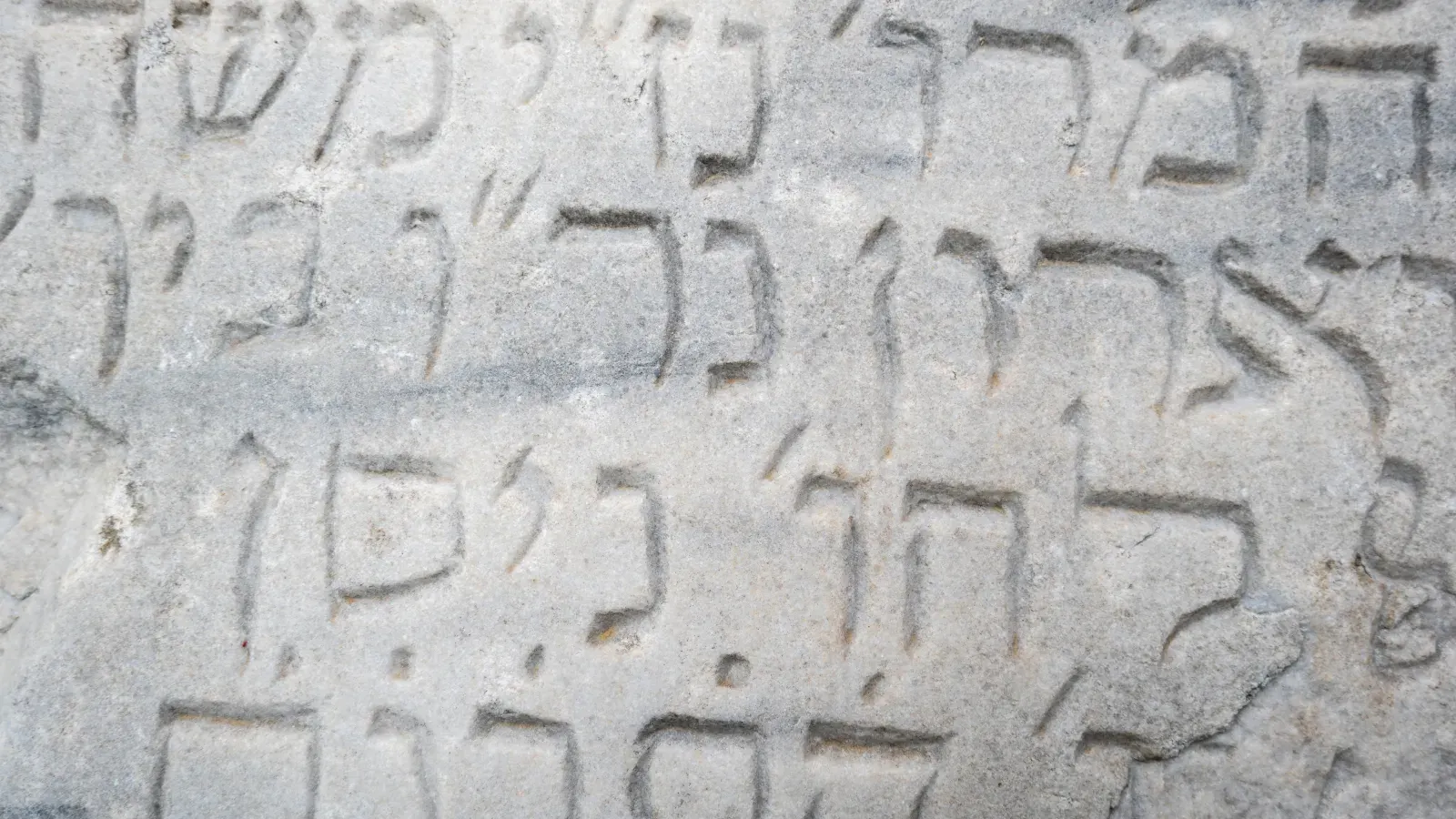
Written Hebrew appears earlier in the archaeological record. The Gezer Calendar, a short inscription found in Israel, is dated to the 10th century BCE by the Biblical Archaeology Society and is often cited as one of the earliest known Hebrew texts, though some scholars classify its language as Phoenician or another Canaanite dialect. One of the earliest inscriptions in the Arabic language, the Namara inscription from southern Syria, is dated 328 CE and is held at the Louvre. It is written in Nabataean script, before the Arabic alphabet took its familiar form.
Earlier written records do not make a language older as a spoken language. Speech existed long before anyone wrote it down, and both languages have ancestors that predate their first inscriptions.
What do people get wrong about Arabic and Hebrew?
Because the two languages are related, a few assumptions come up again and again.
| Common belief | What is actually true |
|---|---|
| Arabic and Hebrew speakers understand each other | They share roots, but conversation is not mutually understandable without study |
| Learning one alphabet lets you read the other | The scripts are completely different |
| Hebrew is only an ancient language | Modern Hebrew is a living language spoken daily by millions |
| Arabic is harder in every way | Both scripts skip short vowels, and Hebrew grammar has its own tricky verb patterns |
| Shared roots mean shared meanings every time | Many roots drifted, so related words can mean different things |
Should you learn Arabic or Hebrew first?
Choose based on where and with whom you will use the language. UNESCO counts more than 400 million Arabic speakers across many countries, and Arabic has been an official United Nations language since 1973. Hebrew is the main language of Israel and is studied widely for history, literature and family ties.
Learning one does speed up the other. Students who know Hebrew recognize Arabic roots and grammar patterns, and Arabic speakers find Hebrew vocabulary familiar. The scripts and sounds remain separate skills. LanguageBird teaches both Arabic and Hebrew in live one to one classes with native level instructors, so students who want both can study them side by side.
I am a native speaker of Arabic and Hebrew, and I have been teaching both languages as a second language for more than 7 years.
Aya H, Arabic & Hebrew Instructor at LanguageBird
Frequently Asked Questions About Arabic vs Hebrew
Are Arabic and Hebrew similar?
Yes, in structure. Both are Semitic languages written right to left, both build words from three letter roots, and both share many basic words, such as shalom and salām for peace. Their alphabets, sound systems and much of their vocabulary differ, so a speaker of one cannot understand the other without study.
Can Hebrew speakers understand Arabic?
Not without study. Hebrew and Arabic speakers recognize some shared words and grammar patterns, especially in basic vocabulary such as numbers, family and everyday objects. The scripts are different, the sounds differ, and many related roots have drifted in meaning, so real conversation still requires learning the other language.
Which is older, Hebrew or Arabic?
Both descend from Proto Semitic, so neither is simply older as a spoken language. Written Hebrew appears earlier: the Gezer Calendar is dated to the 10th century BCE by the Biblical Archaeology Society. One of the earliest Arabic language inscriptions, the Namara inscription, is dated 328 CE. Written records show when people began writing a language down.
Is Hebrew easier to learn than Arabic?
For English speakers, Hebrew usually takes less time. The US Foreign Service Institute estimates about 1,100 class hours for Hebrew and about 2,200 for Arabic. Arabic has more difficult throat sounds, case endings in formal grammar, and a split between Modern Standard Arabic and the spoken dialects that Hebrew does not have.
Do Arabic and Hebrew use the same alphabet?
No. Hebrew uses 22 letters that stand apart in print, five of which have a special final form. Arabic uses 28 letters that connect in cursive and change shape by position. Both scripts come from a common ancestor and both usually omit short vowels, but a reader of one cannot read the other without learning it.
What words are the same in Arabic and Hebrew?
Many basic words share a root. Examples include shalom and salām for peace, yom and yawm for day, bayit and bayt for house, kelev and kalb for dog, and melekh and malik for king. Numbers are also related, such as shalosh and thalātha for three. Pronunciation and spelling differ in each case.
Can high school students take Arabic or Hebrew for credit online?
Yes. When a school does not offer Arabic or Hebrew, students can take either one through an accredited online school and transfer the credit after a counselor approves it. LanguageBird offers accredited middle and high school credit in both languages through live one to one classes with native level instructors, and the high school course catalog lists the Arabic and Hebrew courses.
Learn Arabic or Hebrew With a Live Instructor
Shared roots give learners of these languages a real advantage, but the alphabet, the sounds and the speaking rhythm still need practice with someone who corrects you as you go.
LanguageBird offers live one to one classes with native level instructors in more than a dozen languages. Students can earn accredited middle and high school credit, and our A to G approved courses count toward University of California admission requirements. Explore the Arabic program and the Hebrew program, or browse the high school course catalog.