
 Sign In


Every statistic in this article was checked against its original source on October 21, 2026.
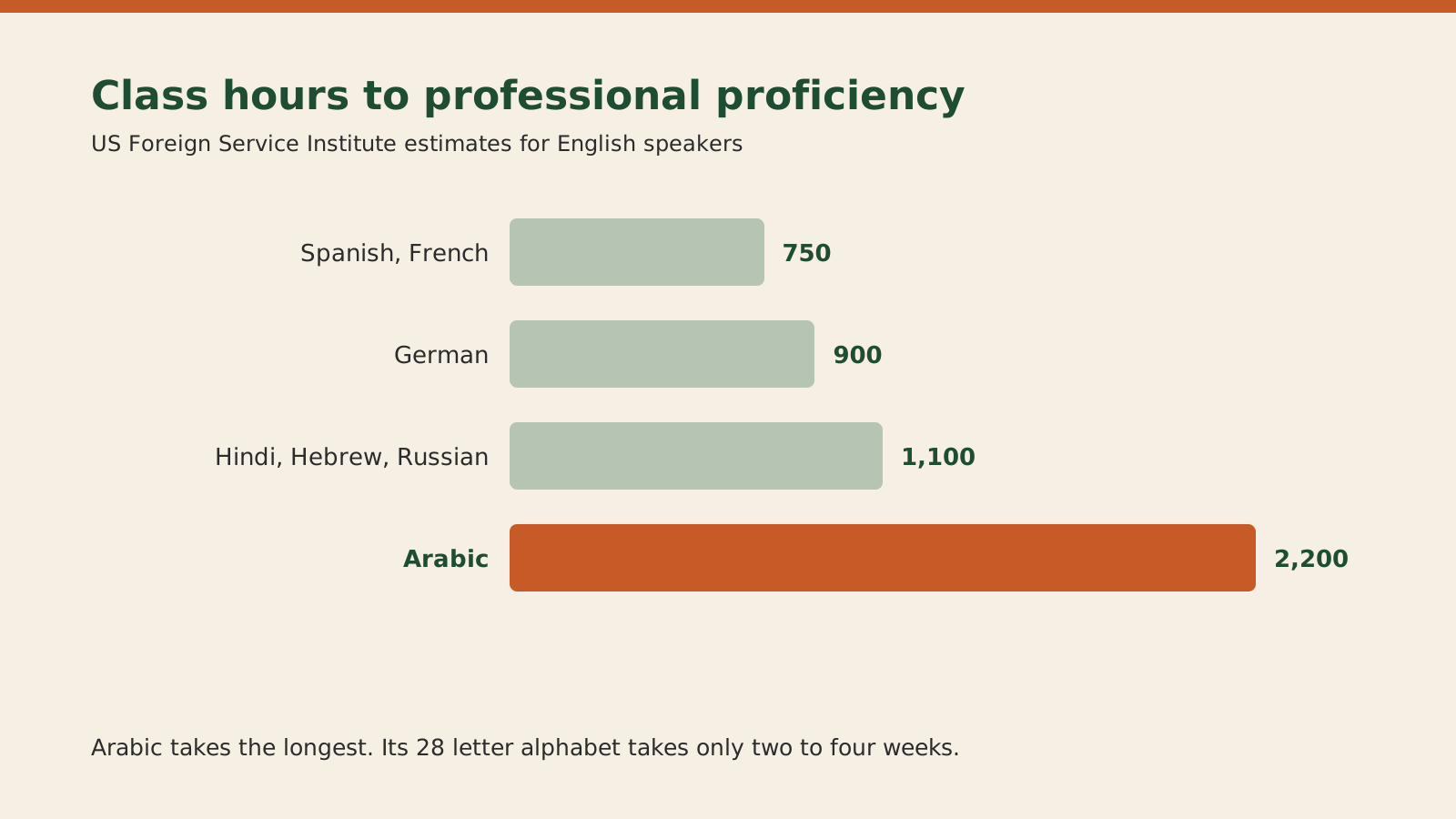
Yes, for an English speaker Arabic is one of the longer languages to learn, but it is uneven: the alphabet takes weeks, while speaking comfortably takes years. The US Foreign Service Institute puts Arabic in its longest category, at about 88 weeks of full time study.
So is Arabic hard to learn? The honest answer depends on which part you mean. Reading the script is faster than most people expect. The sounds, the grammar and the gap between written Arabic and the dialects people speak at home are what stretch the timeline. This guide breaks each piece down, and the LanguageBird Arabic program page shows how live one to one classes are structured around them.
Quick Answer
Arabic is a Category IV language for English speakers, which the US Foreign Service Institute estimates at 88 weeks, or about 2,200 class hours, to professional proficiency. The 28 letter alphabet usually takes two to four weeks to read. Most of the time goes into new sounds, root based grammar and the dialects.
Key Takeaways
- The Foreign Service Institute estimates about 2,200 class hours for Arabic, almost three times the hours for Spanish.
- The Arabic alphabet has 28 letters written right to left, and most learners can sound out words within a month.
- Arabic builds words from three letter roots, so one root such as k t b gives book, writer, office and library.
- Modern Standard Arabic is used for news and writing, while daily conversation happens in regional dialects.
- Arabic normally leaves out the verb “to be” in the present tense, which makes many basic sentences shorter than in English.
Is Arabic hard to learn compared to other languages?
Arabic takes longer than most languages because almost nothing transfers from English: the script, the sound system, the grammar and most of the vocabulary are new at once. Learners also have to manage two registers, the formal written language and the spoken dialects.
The Foreign Service Institute groups languages by how long its students, all native English speakers, take to reach professional working proficiency. Arabic sits in the top group with Mandarin, Japanese and Korean.
| FSI category | Weeks of study | Class hours | Example languages |
|---|---|---|---|
| I | 24 to 30 | 600 to 750 | Spanish, French, Italian, Portuguese |
| II | 36 | 900 | German |
| III | 44 | 1,100 | Hindi, Hebrew, Russian, Greek |
| IV | 88 | 2,200 | Arabic, Mandarin, Japanese, Korean |
That table measures a full program of classes. A high school student studying a few hours a week is on a longer calendar, which is normal and does not mean progress is slow.
How hard is the Arabic alphabet?
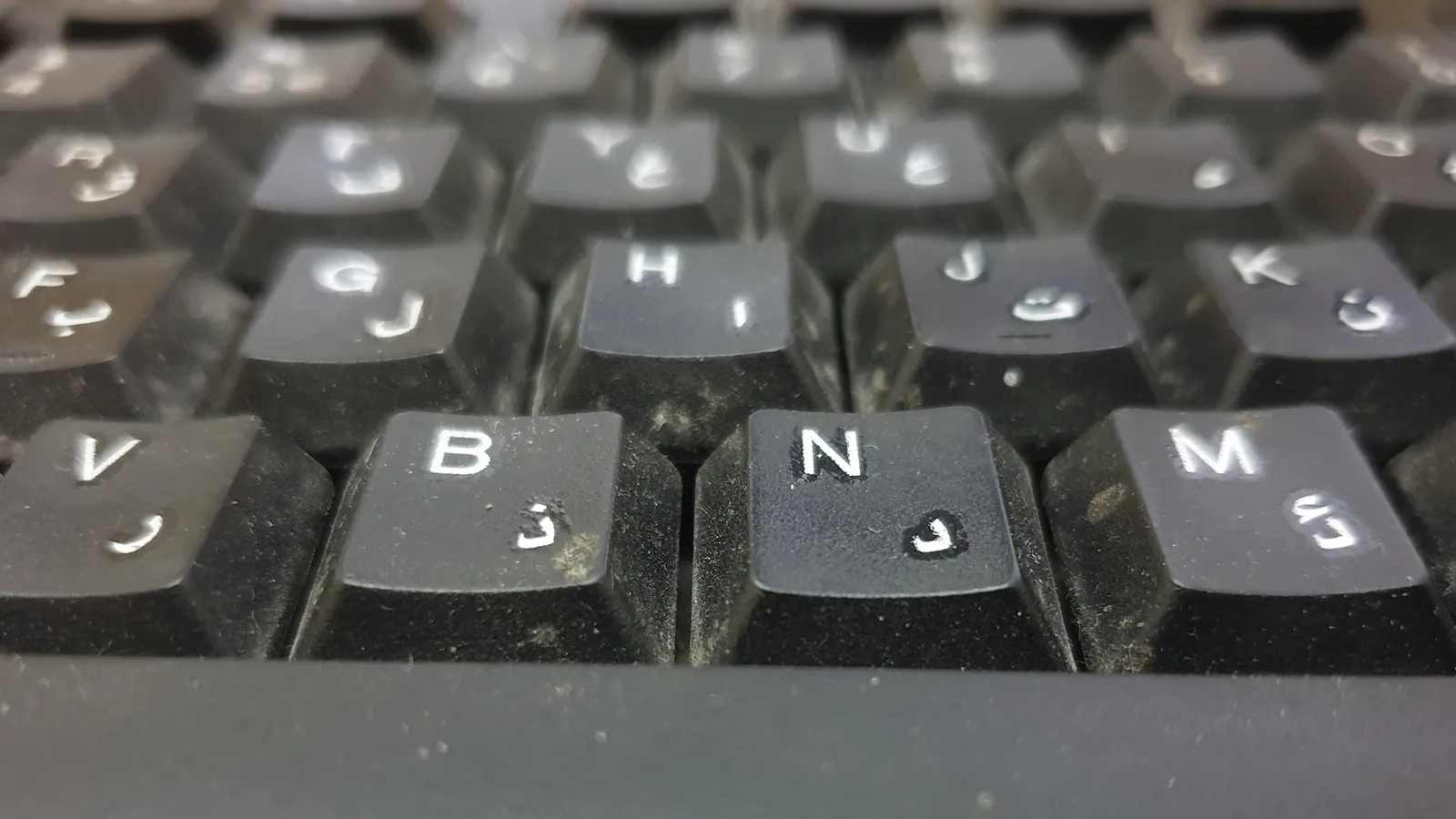
The Arabic alphabet is the part learners most fear and usually the part they finish first. It has 28 letters, it runs right to left, and most students read simple words within two to four weeks of daily practice.
Three features take adjustment. Letters connect in cursive and change shape slightly depending on where they sit in a word, with up to four forms each. Short vowels are usually left out of everyday writing, so readers fill them in from context. And several letters differ only by dots above or below the same base shape.
The upside is consistency. Once you know the letters, Arabic spelling is far more regular than English spelling. For a side by side breakdown of the two writing systems, see our comparison of the Latin and Arabic alphabets.
Which Arabic sounds are hardest for English speakers?
The hardest sounds are the ones made deep in the throat, which English does not use at all. Most learners need a teacher to hear the difference before they can produce it.
| Letter | Approximate sound | Why it is hard |
|---|---|---|
| ع (ayn) | A tightening deep in the throat | No English equivalent |
| ح (ḥa) | A breathy h from the throat | Often confused with the ordinary h |
| ق (qaf) | A k pronounced further back | Sounds like k to new ears |
| خ (kha) | Like ch in Scottish loch | Familiar only to some speakers |
| ص ض ط ظ | Heavy versions of s, d, t and the th in “this” | The difference changes word meaning |
These sounds matter because they separate words. Qalb means heart, while kalb means dog. A teacher who corrects these in the first months saves years of unclear speech later.
What makes Arabic grammar different?
Arabic grammar is built on a root and pattern system, where most words come from a core of three consonants. Patterns of vowels and extra letters around that root create related words.
The root k t b, linked to writing, shows how much one root can do:
| Arabic word | Pattern meaning | English |
|---|---|---|
| kataba | he did the action | he wrote |
| kitāb | the object | book |
| kātib | the person who does it | writer |
| maktab | the place | office or desk |
| maktaba | the place for books | library |
Once the system clicks, new vocabulary becomes partly predictable. Other features take longer: verbs change for gender in the second and third person, nouns have a dual form for exactly two things, and many plurals are “broken”, meaning the word changes inside instead of adding an ending, so kitāb becomes kutub.
What is the difference between Modern Standard Arabic and the dialects?
Modern Standard Arabic is the shared written and formal language of the Arab world, while dialects are what people speak at home, with friends and on the street. Linguists call this split diglossia.
| Modern Standard Arabic | Spoken dialects | |
|---|---|---|
| Where you hear it | News, books, speeches, signs | Family, friends, shops, television series |
| Who understands it | Educated speakers across every Arab country | Speakers from the same region, with less overlap far away |
| Main groups | One standard | Egyptian, Levantine, Gulf, Iraqi, Maghrebi |
| Written form | Fully standardized | Mostly informal, in texts and social media |
Egyptian and Levantine Arabic are widely understood because of film, television and music. Moroccan and Algerian Arabic, often called Darija, are the hardest for other Arabic speakers to follow.
Which one to start with depends on the goal. Students who want to read, study religion, history or politics, or work across several countries usually begin with Modern Standard Arabic. Students with family ties to one region often add that dialect early. In our Arabic program, instructors teach both Modern Standard Arabic and spoken dialects, so students build the formal base and the everyday language together.
After relocating to the U.S. in 2017, I used my expertise in Arabic, including Modern Standard Arabic (MSA) and dialects, to teach members of the U.S. military online.
Mushtaq Al, Arabic Instructor at LanguageBird
Which parts of Arabic go faster than people expect?
Several features of Arabic save time once you are past the first few months. They do not shorten the overall timeline much, but they make steady progress feel possible.
- Arabic normally leaves out the verb “to be” in the present tense. Ana ṭālib means “I am a student”, with no word for “am”.
- Spelling is consistent once you learn the letters and vowels.
- The root system turns one new root into several new words at once.
- English already uses Arabic loanwords such as algebra, coffee, cotton, sugar, sofa and zero, many of them through Latin, Italian, French or Spanish, as our article on Arabic influence on Spanish explains.
- The language reaches a large audience. UNESCO counts more than 400 million Arabic speakers, and Arabic has been an official United Nations language since 1973.
What do people get wrong about learning Arabic?
Most of the fear around Arabic comes from a few assumptions that do not hold up once lessons start.
| Common belief | What is actually true |
|---|---|
| The script takes years | Most learners read basic words within two to four weeks |
| You have to choose MSA or a dialect forever | Most learners start with one and add the other, since grammar and vocabulary overlap |
| Arabic is one impossible language | It is a set of skills on different timelines: script fast, sounds medium, fluency slow |
| You need to live abroad to make progress | Live lessons with a native level instructor build speaking and listening from home |
| Grammar has to come before speaking | Students hold simple conversations within a few months using short, fixed patterns |
How long does it take to learn Arabic?
Basic reading takes about a month, simple conversation takes six months to a year of regular lessons, and professional fluency takes several years. The Foreign Service Institute figure of 2,200 class hours describes full time, intensive study.
| Stage | Typical time with regular lessons | What you can do |
|---|---|---|
| Alphabet | 2 to 4 weeks | Read and write all 28 letters, sound out short words |
| Survival Arabic | 3 to 6 months | Greet, introduce yourself, ask for directions, order food |
| Conversational | 1 to 2 years | Hold everyday conversations on familiar topics |
| Professional | 3 or more years | Follow the news, read articles, handle work conversations |
Students who start in middle or high school have an advantage, because the extra years let the sounds settle before the grammar gets heavy. Our post on the advantages of learning Arabic online covers how that plays out for students.
How should a beginner start learning Arabic?
Start with the alphabet and the sounds together, then build a core of everyday phrases before moving into grammar. This order gives students something they can say from the first weeks.
- Learn the 28 letters and their connected forms, reading aloud every day.
- Practice the throat sounds with a teacher who can correct you.
- Memorize greetings and survival phrases. Our list of Arabic phrases and expressions for beginners is a good starting set.
- Learn the root and pattern idea early, using one familiar root at a time.
- Speak from the first month, even in short sentences.
In the Arabic program, LanguageBird teaches through live one to one classes with native level instructors, which matters most at steps two and five, the two that are hard to do alone.
Frequently Asked Questions About Learning Arabic
Is Arabic harder than Spanish for English speakers?
Yes. The US Foreign Service Institute estimates about 2,200 class hours for Arabic and about 750 hours for Spanish, so Arabic takes roughly three times as long. Spanish shares an alphabet and thousands of related words with English. Arabic needs a new script, new sounds and a grammar built on three letter roots.
How long does it take to learn the Arabic alphabet?
Most learners can read and write the 28 Arabic letters within two to four weeks of daily practice. The letters change shape slightly depending on their position in a word, and short vowels are usually not written, so reading quickly takes longer. Sounding out simple words, though, comes within the first month.
Should I learn Modern Standard Arabic or a dialect first?
It depends on your goal. Modern Standard Arabic is the right start for reading, the news and formal settings across all Arab countries. A dialect such as Egyptian or Levantine is better for everyday conversation in one region. Many learners start with one and add the other later, because the two share most grammar and vocabulary.
What is the hardest part of learning Arabic?
For most English speakers, the hardest part is the sound system, especially throat sounds such as ayn and ha that English does not have. These sounds change word meaning, so they cannot be skipped. The second challenge is diglossia, the gap between Modern Standard Arabic and the spoken dialects people use at home.
Can you learn Arabic online?
Yes. Live online lessons with a native level instructor cover the parts of Arabic that are hardest alone: pronunciation feedback, listening practice and conversation. Self study apps help with the alphabet and vocabulary. Speaking practice with correction is what moves a learner from reading Arabic to actually using it with other people.
Is Arabic worth learning?
UNESCO counts more than 400 million Arabic speakers, and Arabic has been an official language of the United Nations since 1973. Few US students study it, so Arabic skills stand out in diplomacy, journalism, international business, security and research. It also opens access to centuries of literature, history and scholarship in the original language.
Can you earn high school credit for Arabic online?
Yes. If a high school does not offer Arabic, students can take it through an accredited online school and transfer the credit to their transcript after a counselor approves it. LanguageBird offers accredited middle and high school credit in Arabic through live one to one classes with native level instructors, and the high school course catalog lists the Arabic courses.
Learn Arabic With a Live Instructor
Arabic rewards patience, and it rewards correction even more. The throat sounds, the dropped vowels and the switch between formal and spoken Arabic are all things a student improves fastest with someone listening in real time.
LanguageBird offers live one to one classes with native level instructors in more than a dozen languages. Students can earn accredited middle and high school credit, and our A to G approved courses count toward University of California admission requirements. Explore the Arabic program or browse the high school course catalog.