
 Sign In


Every statistic in this article was checked against its original source on October 21, 2026.
English and Spanish differ most in grammatical gender, verb endings and pronunciation, and they overlap most in vocabulary. A Spanish noun is always masculine or feminine, a Spanish verb changes its ending for every person, and Spanish spelling matches its sound almost perfectly.
Comparing English vs Spanish side by side is the fastest way to see where an English speaker will have to rewire habits and where a lot of work is already done. This guide stays on structure, with real sentences in both languages. For lessons built around these differences, see the LanguageBird Spanish program.
Quick Answer
The three biggest differences in English vs Spanish are grammatical gender, which gives every Spanish noun a masculine or feminine form, verb endings that change for each person, and phonetic spelling with only five vowel sounds. The biggest similarity is vocabulary: 30 to 40 percent of English words have a related word in Spanish.
Key Takeaways
- Every Spanish noun has a grammatical gender, and the articles and adjectives around it change to match.
- Spanish verbs take a different ending for each person, so the subject pronoun is often dropped.
- Spanish has five vowel sounds, while American English has more than a dozen depending on the accent.
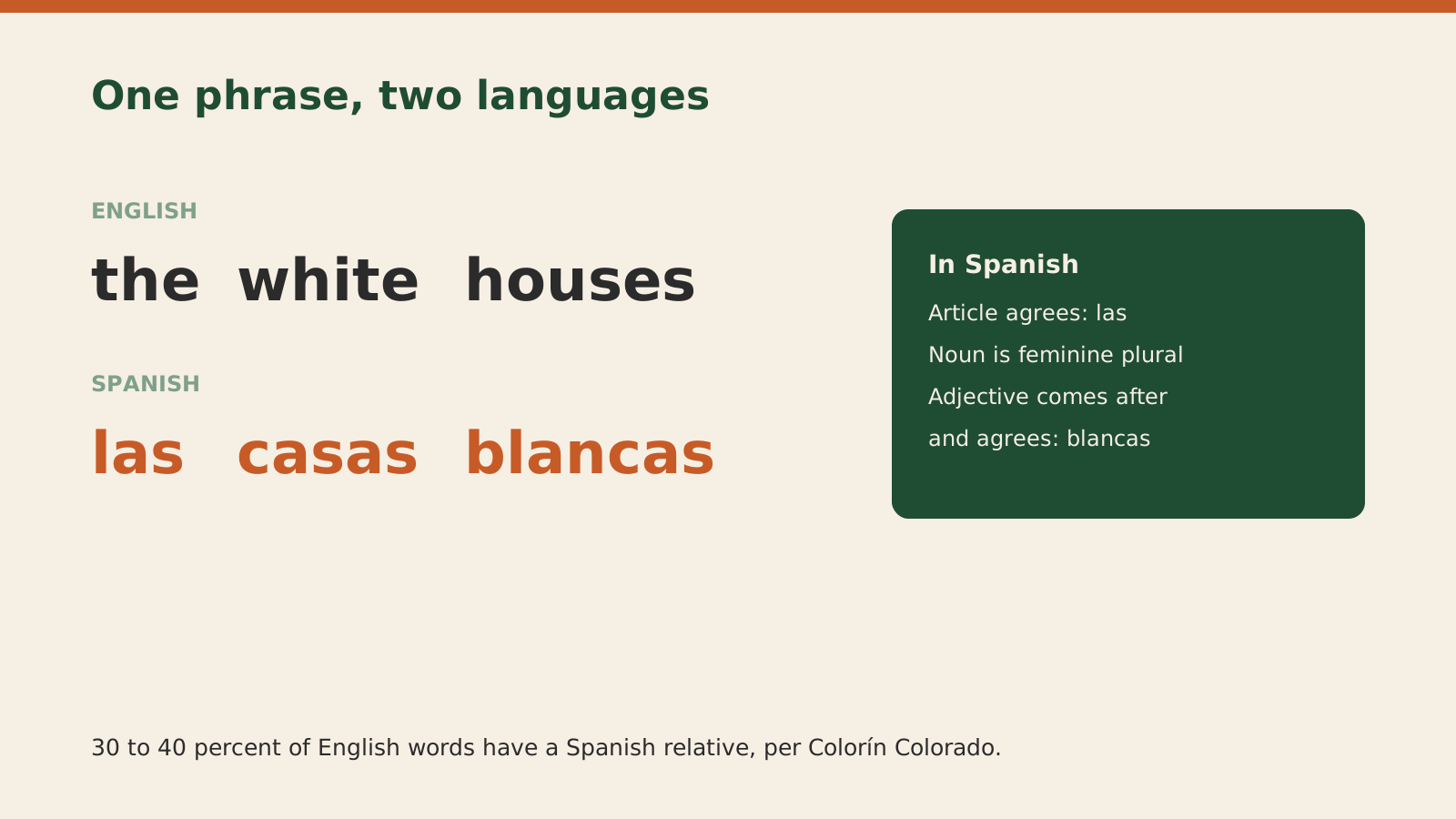
- Spanish adjectives usually come after the noun: la casa blanca means “the white house”.
- Colorín Colorado, the bilingual education resource, estimates that 30 to 40 percent of English words have a Spanish relative.
What are the biggest differences in English vs Spanish?
The biggest differences show up in five places: gender, word order, verb forms, pronunciation and a few grammar rules English simply does not have. The table puts the same idea in both languages so the contrast is visible.
| Feature | English | Spanish | What changes |
|---|---|---|---|
| Gender | the red car, the red house | el coche rojo, la casa roja | Article and adjective match the noun |
| Adjective position | a big dog | un perro grande | Most adjectives follow the noun |
| Verb endings | I speak, we speak | hablo, hablamos | Each person has its own ending |
| Subject pronoun | We are tired. | Estamos cansados. | The pronoun is usually dropped |
| Questions | Where is the library? | ¿Dónde está la biblioteca? | Opening question mark, no helper verb |
| Negatives | I do not see anything. | No veo nada. | Double negatives are required after the verb |
| Two verbs for “to be” | She is tall. She is tired. | Es alta. Está cansada. | Ser for traits, estar for states |
How does grammatical gender work in Spanish?
Spanish assigns every noun a gender, masculine or feminine, and the words around the noun change to agree with it. English only marks gender on a few pronouns such as he and she.
Gender in Spanish is a grammar label. It says nothing about the object itself. La mesa, the table, is feminine. El libro, the book, is masculine. Endings give strong clues: most nouns ending in o are masculine and most ending in a are feminine, with exceptions such as el día, el mapa and la mano.
The agreement chain is what trips English speakers up. In las casas blancas, the white houses, the article, the noun and the adjective all carry feminine plural endings. English says “the white houses” with no change at all.
How is Spanish word order different from English?
Both languages use subject, verb, object as their basic order, so a simple sentence lines up. The differences come in adjectives, pronouns and questions.
- Adjectives usually follow the noun: un libro interesante, an interesting book.
- Object pronouns come before the conjugated verb: Lo veo means “I see it”.
- Questions often keep statement order and rely on intonation and the opening ¿.
- Spanish word order is more flexible, because verb endings already show who is doing what.
A small number of common adjectives can go before the noun and shift meaning. Un gran hombre means “a great man”, while un hombre grande means “a big man”.
How do verbs differ between English and Spanish?
Spanish verbs carry far more information in their endings than English verbs do. English mostly adds s for he or she and ed for the past, while Spanish uses a distinct ending for each person in each tense.
| Subject | English | Spanish (hablar) |
|---|---|---|
| I | speak | hablo |
| you | speak | hablas |
| he, she | speaks | habla |
| we | speak | hablamos |
| they | speak | hablan |
Because the ending already says who is acting, Spanish speakers usually drop the pronoun. Hablo español is complete. Starting with the present tense in Spanish is the standard way to build this habit.
Spanish also makes distinctions English leaves to context. It has two verbs for “to be”, ser and estar. It has two simple past tenses, the preterite and the imperfect. And it uses the subjunctive mood after wishes, doubts and emotions, where English uses the ordinary verb.
How is Spanish pronunciation different from English?
Spanish pronunciation is more consistent than English pronunciation, because each letter has one main sound. Once you learn the rules, you can read a new Spanish word aloud correctly the first time.
| Feature | English | Spanish |
|---|---|---|
| Vowel sounds | More than a dozen, depending on the accent | Five: a, e, i, o, u |
| Spelling and sound | Often unrelated (though, tough, through) | Close to one sound per letter |
| Rhythm | Stress timed, with weak unstressed syllables | Syllable timed, each syllable roughly even |
| Written stress marks | None | Accents show stress: teléfono, canción |
| R sounds | One r sound | A tap (pero) and a trill (perro) |
The vowel difference matters most for comprehension. English speakers tend to shorten unstressed vowels into a neutral “uh” sound, which makes Spanish words harder to recognize. Keeping every vowel clear is the first pronunciation habit most teachers correct.

What do English and Spanish have in common?
English and Spanish share a large stock of vocabulary through Latin, and they share the same alphabet apart from ñ. That overlap gives English speakers a head start few other languages offer.
Colorín Colorado, a national bilingual education resource, estimates that 30 to 40 percent of all words in English have a related word in Spanish. Many follow predictable patterns:
| English ending | Spanish ending | Examples |
|---|---|---|
| tion | ción | nation, nación; information, información |
| ty | dad | city, ciudad; university, universidad |
| ous | oso | famous, famoso; delicious, delicioso |
| ly | mente | rapidly, rápidamente; finally, finalmente |
Borrowing runs the other way too. English took words such as canyon, plaza, patio, rodeo and tornado from Spanish. Our article on English words from other languages traces more of them.
Which English and Spanish words look alike but mean different things?
False friends are words that look similar in both languages but have different meanings. They cause some of the most memorable mistakes learners make.
| Spanish word | Looks like | Actually means |
|---|---|---|
| embarazada | embarrassed | pregnant |
| éxito | exit | success |
| librería | library | bookstore |
| actual | actual | current |
| carpeta | carpet | folder |
| constipado | constipated | having a cold |
| sensible | sensible | sensitive |
| realizar | realize | to carry out |
What do people get wrong when comparing English and Spanish?
A few assumptions about the two languages lead students in the wrong direction early on.
| Common belief | What is actually true |
|---|---|
| Spanish grammar works like English with different words | Gender, verb endings and two forms of “to be” have no English equivalent |
| You can translate word for word | Word order, pronouns and negatives often change |
| Cognates always mean the same thing | False friends like embarazada and éxito are common |
| Accent marks are optional | They change meaning: el means “the”, él means “he” |
| Spanish pronunciation is as unpredictable as English | Spanish spelling is close to fully phonetic |
English vs Spanish: which is harder to learn?
Each direction has its own hard parts. English speakers struggle with Spanish gender and verb endings, while Spanish speakers struggle with English spelling and vowel sounds.
For English speakers, the US Foreign Service Institute puts Spanish in its fastest group, at about 30 weeks of full time study. The effort pays off at scale: the Instituto Cervantes 2025 yearbook counts about 635 million people who can use Spanish worldwide. Our guide to how hard Spanish is to learn covers difficulty and timelines in detail. For guided practice in either direction, our Spanish program and ESL program both use live one to one classes with native level instructors.
I also have a B.A. in teaching English, Spanish, and French, which means I understand the challenges and joys of learning a new language.
Yury T, ESOL & Spanish Instructor at LanguageBird
Frequently Asked Questions About English vs Spanish
What is the biggest difference between English and Spanish?
For most learners, the biggest difference is grammatical gender. Every Spanish noun is masculine or feminine, and articles and adjectives must agree with it, as in el coche rojo and la casa roja. English has nothing similar beyond pronouns like he and she, so gender agreement becomes a new habit that takes months to automate.
Do English and Spanish share a lot of words?
Yes. Colorín Colorado, the bilingual education resource, estimates that 30 to 40 percent of English words have a related word in Spanish, mostly through Latin. Patterns such as nation and nación or city and ciudad make many words recognizable on sight. Watch for false friends, though, such as embarazada, which means pregnant.
Is Spanish grammar similar to English grammar?
Both languages share the basic subject, verb, object order, so simple sentences line up. Beyond that, Spanish grammar adds gender agreement, a verb ending for each person, two verbs for “to be”, two simple past tenses and the subjunctive mood. English relies more on word order and helper words like do and will.
Why do Spanish speakers drop the subject pronoun?
Spanish verb endings already show who is acting. Hablamos can only have nosotros as its subject, so the pronoun is unnecessary. Speakers add the pronoun for emphasis or contrast, as in yo hablo español, pero él no. English verbs change too little to drop the pronoun, which is why “speak Spanish” sounds like a command in English.
Is Spanish pronunciation harder than English pronunciation?
For learners, Spanish pronunciation is more predictable. It has five vowel sounds and spelling that closely matches sound, so new words can be read aloud correctly. English has more than a dozen vowel sounds and inconsistent spelling. The main Spanish challenges for English speakers are the rolled r and keeping unstressed vowels clear.
Can knowing English help you learn Spanish faster?
Yes. Shared vocabulary, the same alphabet and the same basic word order save English speakers months of work. The US Foreign Service Institute places Spanish in its fastest category for English speakers, at about 30 weeks of full time study. Gender and verb endings are where most of the extra effort goes.
How many years of Spanish do colleges expect?
The University of California requires two years of the same language other than English and recommends three. Other colleges set their own expectations, so check each admissions page. LanguageBird offers A to G approved courses and accredited middle and high school credit through live one to one classes with native level instructors, and the high school course catalog lists the Spanish courses.
Learn Spanish With Someone Who Knows Both Languages
Seeing the differences on a chart is the first step. Hearing your own gender slips and dropped vowels, and fixing them while you talk, is what makes them disappear.
LanguageBird offers live one to one classes with native level instructors in more than a dozen languages. Students can earn accredited middle and high school credit, and our A to G approved courses count toward University of California admission requirements. Explore the Spanish program and the ESL program, or browse the high school course catalog.
Sources
- US Department of State, Foreign Service Institute: Foreign Language Training
- Instituto Cervantes, El español en el mundo 2025 (yearbook)
- Colorín Colorado, Using cognates
- University of California Admissions, Subject requirement A to G