
 Sign In


Every statistic in this article was checked against its original source on October 21, 2026.
The Spanish subjunctive is a verb mood for wishes, doubts, emotions and situations that are not settled fact. Where the indicative says “this is true”, the subjunctive says “I want this”, “I doubt this” or “this might happen”.
Most students meet the Spanish subjunctive in their second or third year of study, and it is the point where many stall. The rules fit on one page. What takes time is hearing the trigger fast enough to pick the right form while you speak, which is why the LanguageBird Spanish program builds it into conversation from the first lessons where it appears.
Quick Answer
The Spanish subjunctive is a verb mood used after expressions of wishes, emotions, doubt, recommendations and impersonal judgments, usually in a clause that starts with que. Quiero que vengas means “I want you to come”. To form it, take the yo form, drop the o and switch to the opposite vowel ending.
Key Takeaways
- The subjunctive is a mood, so it exists in four tenses: present, imperfect, present perfect and pluperfect.
- It almost always appears in a second clause introduced by que, after a trigger in the first clause.
- Verbs ending in ar take e endings in the present subjunctive, and verbs ending in er and ir take a endings.
- Six verbs are irregular in the present subjunctive: dar, ir, saber, ser, estar and haber.
- Creer que takes the indicative, while no creer que takes the subjunctive, because doubt is the trigger.
What is the subjunctive in Spanish?
The subjunctive is one of three verb moods in Spanish, alongside the indicative and the imperative. A mood tells the listener how the speaker relates to the action: as a fact, as a command, or as something wished for, doubted or imagined.
Tense and mood answer different questions. Tense says when something happens. Mood says how certain or real the speaker thinks it is. That is why the label “subjunctive tense in Spanish” is a little off: the subjunctive has its own present and past forms, just as the indicative does.
| Mood | What it expresses | Example | Translation |
|---|---|---|---|
| Indicative | Facts and certainty | Sé que vienes. | I know you are coming. |
| Subjunctive | Wishes, doubt, emotion, the unreal | Espero que vengas. | I hope you come. |
| Imperative | Direct commands | Ven aquí. | Come here. |
English still has traces of a subjunctive. “If I were you” and “I suggest that he be on time” both use it. Spanish just uses the mood far more often, in everyday speech, at every level of formality.
When do you use the subjunctive in Spanish?
You use the subjunctive when the main clause expresses a wish, an emotion, a doubt, a recommendation or a judgment about something that is not yet fact. The subjunctive verb then sits in the second clause, after que.
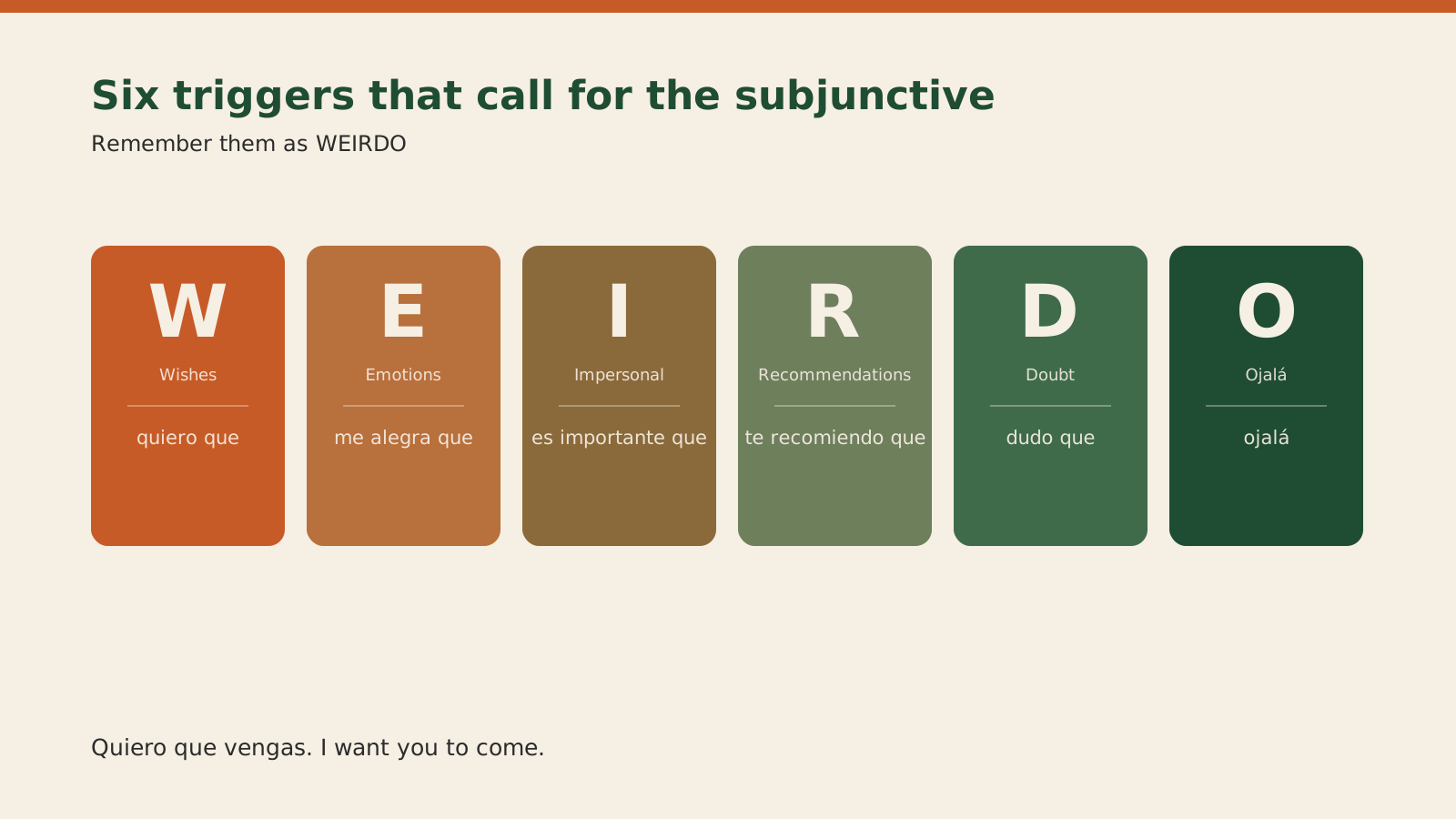
A common memory aid groups the triggers under the letters WEIRDO: Wishes, Emotions, Impersonal expressions, Recommendations, Doubt and denial, and Ojalá.
| Trigger group | Common phrases | Example | Translation |
|---|---|---|---|
| Wishes | quiero que, espero que, prefiero que | Quiero que me llames. | I want you to call me. |
| Emotions | me alegra que, siento que, tengo miedo de que | Me alegra que estés aquí. | I am glad you are here. |
| Impersonal expressions | es importante que, es necesario que, es posible que | Es importante que estudies. | It is important that you study. |
| Recommendations | te recomiendo que, sugiero que, te pido que | Te recomiendo que leas esto. | I recommend that you read this. |
| Doubt and denial | dudo que, no creo que, no es verdad que | Dudo que llegue a tiempo. | I doubt he will arrive on time. |
| Ojalá | ojalá, ojalá que | Ojalá haga sol mañana. | I hope it is sunny tomorrow. |
Why does the subject have to change?
The subjunctive usually appears when two different people are involved: one person wants, doubts or feels something about what another person does. When the subject stays the same, Spanish uses the infinitive instead.
- Quiero ir al cine. I want to go to the movies.
- Quiero que vayas al cine. I want you to go to the movies.
Writing quiero que yo vaya sounds wrong to a native ear. If you catch yourself writing que followed by the same subject, switch to the infinitive.
Which conjunctions trigger the subjunctive?
Some conjunctions always take the subjunctive because the action they introduce has not happened yet or depends on a condition. Others take it only when they point to the future.
| Always subjunctive | Subjunctive only for future events |
|---|---|
| para que (so that) | cuando (when) |
| antes de que (before) | hasta que (until) |
| a menos que (unless) | en cuanto (as soon as) |
| sin que (without) | después de que (after) |
| con tal de que (provided that) | tan pronto como (as soon as) |
Compare cuando in two sentences. Cuando llego a casa, como means “When I get home, I eat”, a habit stated as fact, so it takes the indicative. Cuando llegues a casa, llámame means “When you get home, call me”, which has not happened yet, so it takes the subjunctive.
Connectors like these also shape how a paragraph flows. Our guide to Spanish transition words marks which ones require the subjunctive.

How do you form the present subjunctive?
To form the present subjunctive, take the yo form of the present indicative, drop the final o, and add the opposite vowel ending. Verbs ending in ar switch to e endings, and verbs ending in er and ir switch to a endings.
| Subject | hablar (ar) | comer (er) | vivir (ir) |
|---|---|---|---|
| yo | hable | coma | viva |
| tú | hables | comas | vivas |
| él, ella, usted | hable | coma | viva |
| nosotros | hablemos | comamos | vivamos |
| vosotros | habléis | comáis | viváis |
| ellos, ellas, ustedes | hablen | coman | vivan |
Starting from the yo form matters because it carries irregular stems across. Tengo becomes tenga, hago becomes haga, conozco becomes conozca, salgo becomes salga. If you know the present tense in Spanish well, most of the present subjunctive comes free.
Which verbs are irregular in the present subjunctive?
Six verbs do not follow the yo form rule. Students often remember them with the acronym DISHES.
| Infinitive | yo | nosotros | ellos |
|---|---|---|---|
| dar (to give) | dé | demos | den |
| ir (to go) | vaya | vayamos | vayan |
| saber (to know) | sepa | sepamos | sepan |
| haber (auxiliary) | haya | hayamos | hayan |
| estar (to be) | esté | estemos | estén |
| ser (to be) | sea | seamos | sean |
What about spelling changes and stem changes?
Verbs ending in car, gar and zar change their spelling to keep the original sound: buscar becomes busque, llegar becomes llegue, and cruzar becomes cruce. The pronunciation stays the same. Only the letters move.
Stem changing verbs keep their change in the same forms as the present indicative, so pensar gives piense but pensemos. Stem changing verbs ending in ir also change the stem in the nosotros and vosotros forms: dormir gives durmamos, sentir gives sintamos and pedir keeps i in pidamos.
What is the imperfect subjunctive?
The imperfect subjunctive is the past form of the subjunctive mood. You use it when the trigger is in the past, in hypothetical “if” sentences, and to make polite requests.
To form it, take the ellos form of the preterite, drop ron, and add the ra endings. Hablaron becomes hablara, tuvieron becomes tuviera, and fueron becomes fuera for both ser and ir. Every irregular preterite passes its irregularity straight into the imperfect subjunctive, so review Spanish past tense conjugation first if the preterite still feels shaky.
| Subject | hablar | tener | ser and ir |
|---|---|---|---|
| yo | hablara | tuviera | fuera |
| tú | hablaras | tuvieras | fueras |
| él, ella, usted | hablara | tuviera | fuera |
| nosotros | habláramos | tuviéramos | fuéramos |
| ellos, ellas, ustedes | hablaran | tuvieran | fueran |
A second set of endings in se also exists: hablase, tuviese, fuese. Both sets mean the same thing. The ra forms are the more common set everywhere, and the se forms survive mostly in Spain and in formal writing.
When do you use the imperfect subjunctive?
Three situations account for most of its use.
- A past trigger. Quería que vinieras means “I wanted you to come”.
- Hypothetical if clauses. Si tuviera tiempo, viajaría más means “If I had time, I would travel more”.
- Polite requests. Quisiera un café means “I would like a coffee”, softer than quiero un café.
What are the past subjunctive forms in Spanish?
Spanish has two compound subjunctive forms built with haber, and they cover actions that are already complete. Both work like their indicative versions, with haber in the subjunctive.
- Present perfect subjunctive: haya plus a participle. Espero que hayas comido means “I hope you have eaten”.
- Pluperfect subjunctive: hubiera plus a participle. Si hubiera sabido, habría venido means “If I had known, I would have come”.
The tense of the trigger decides which subjunctive follows. Our full guide to every Spanish conjugation lays out all of the moods side by side.
| Trigger verb | Subjunctive that follows | Example |
|---|---|---|
| Present (quiero) | Present subjunctive | Quiero que vengas. |
| Present perfect (he pedido) | Present subjunctive | He pedido que vengas. |
| Preterite or imperfect (quería) | Imperfect subjunctive | Quería que vinieras. |
| Conditional (querría) | Imperfect subjunctive | Querría que vinieras. |
What mistakes do students make with the Spanish subjunctive?
The most common errors come from a handful of myths about how the mood works. Correcting them early saves months of fossilized mistakes.
| Common belief | What is actually true |
|---|---|
| The subjunctive is rare and formal | It appears daily, in requests, plans, opinions and texts between friends |
| It is a tense | It is a mood with four tenses of its own |
| Creer que always takes the subjunctive | Creo que viene uses the indicative. Only no creo que venga uses the subjunctive |
| Cuando always takes the subjunctive | Only when it points to the future. Habits use the indicative |
| You must master it before speaking | Learners use the common triggers correctly long before they know every rule |
I believe students learn best when they feel comfortable taking risks, making mistakes, and using the language for a real purpose.
Lucia E, Spanish Instructor at LanguageBird
How long does it take to learn the Spanish subjunctive?
Most students can form the present subjunctive within two to three weeks of focused study. Using it automatically in conversation usually takes several months, because the decision has to happen at speaking speed. Speaking practice with correction shortens that stretch, and our Spanish program provides it through live one to one classes with native level instructors.
For context, the US Foreign Service Institute, which trains American diplomats, estimates about 30 weeks, or roughly 750 class hours, for an English speaker to reach professional working proficiency in Spanish. The subjunctive is one of the main skills that separates that level from conversational Spanish.
The payoff is large. The Instituto Cervantes 2025 yearbook counts about 635 million people who can use Spanish, including 520 million native speakers, and every one of them uses the subjunctive without thinking about it.
Frequently Asked Questions About the Spanish Subjunctive
What is the subjunctive in Spanish in simple terms?
The subjunctive is a verb form Spanish uses for things that are wished for, doubted, felt or not yet real. It usually follows que after a trigger such as quiero que or es importante que. The indicative states facts, while the subjunctive expresses attitudes toward an action. Quiero que vengas, I want you to come, is the classic example.
How do you know when to use the subjunctive in Spanish?
Look at the first clause. If it expresses a wish, emotion, doubt, recommendation or impersonal judgment, and the second clause has a different subject introduced by que, use the subjunctive. The acronym WEIRDO covers the main groups: wishes, emotions, impersonal expressions, recommendations, doubt and denial, and ojalá.
Is the subjunctive tense in Spanish a tense or a mood?
It is a mood. Tense tells you when an action happens, while mood tells you how the speaker views it. The subjunctive mood has four tenses: present, imperfect, present perfect and pluperfect. That is why grammar books talk about the present subjunctive and the imperfect subjunctive as separate forms of the same mood.
What are the six irregular verbs in the Spanish present subjunctive?
They are dar, ir, saber, haber, estar and ser, often remembered as DISHES. Their present subjunctive forms are dé, vaya, sepa, haya, esté and sea. Every other verb builds its present subjunctive from the yo form of the present indicative, including irregular ones such as tener, which gives tenga.
What is the difference between the present and imperfect subjunctive?
The present subjunctive follows a trigger in the present, as in quiero que vengas. The imperfect subjunctive follows a trigger in the past or the conditional, as in quería que vinieras. It is also the form used in hypothetical if clauses, such as si tuviera tiempo, viajaría, meaning if I had time, I would travel.
Does creer que take the subjunctive?
Not in the affirmative. Creo que viene states something the speaker believes is true, so it takes the indicative. In the negative, no creo que venga expresses doubt, so it takes the subjunctive. The same pattern holds for pensar que and parecer que. The trigger is doubt, and the verb creer on its own does not create it.
Can high school students earn credit for Spanish online?
Yes, when the course comes from an accredited school and the student’s own school agrees to accept the credit, so it is worth checking with a counselor before enrolling. LanguageBird offers accredited middle and high school credit in Spanish through live one to one classes with native level instructors, and the high school course catalog lists the courses available in each language.
Learn the Spanish Subjunctive in Conversation
Charts make the Spanish subjunctive look manageable, and they are. The hard part is reaching for vengas instead of vienes in the half second you have while someone waits for your answer. That reflex comes from speaking with someone who catches the slip and asks you to try again.
LanguageBird offers live one to one classes with native level instructors in more than a dozen languages. Students can earn accredited middle and high school credit, and our A to G approved courses count toward University of California admission requirements. Explore the Spanish program or browse the high school course catalog.
Sources
- US Department of State, Foreign Service Institute: Foreign Language Training
- Instituto Cervantes, El español en el mundo 2025 (yearbook)